
A Conservative Solution for Discolored Endodontically Treated Teeth
A review of the literature and clinical case highlight how the walking bleach technique can effectively lighten nonvital teeth and offer a minimally invasive alternative to full-coverage restorations for managing post-endodontic discoloration.
Achieving an esthetically pleasing smile heavily relies on the color of the teeth, which significantly impacts a patient’s appearance and mental well-being.1,2 Patient expectations often extend beyond simply addressing the shade of a tooth in need of prosthodontic restoration.3 Bleaching has emerged as a viable alternative to crowning for anterior teeth that have undergone endodontic treatment.4
Restorative procedures involved in placing full-coverage restorations can negatively impact oral health due to the necessary removal of tooth structure. Although crowns are often the most appropriate treatment choice, the placement of a full-coverage restoration for a discolored tooth in an attempt to provide a predictable and permanent solution may not always result in a favorable long-term outcome.5
Tooth discoloration is either intrinsic or extrinsic. While extrinsic discoloration can be caused by chlorhexidine mouthrinses, stannous fluoride exposure, and iron supplements, intrinsic causes are pulp hemorrhage, pulp deterioration, microorganisms and their byproducts, tetracycline, pulp necrosis, intracanal medications, some endodontic filling materials, and metallic restorations.1
Several approaches exist for treating discolored teeth. These vary from invasive methods, such as crowns, veneers, and direct restorations, to less invasive procedures, including macroabrasion, microabrasion, and bleaching.6 The approach to treating discolored teeth differs between vital teeth and those undergoing endodontic treatment. The cause of discoloration and potential underlying infections must be considered before deciding on treatment.7
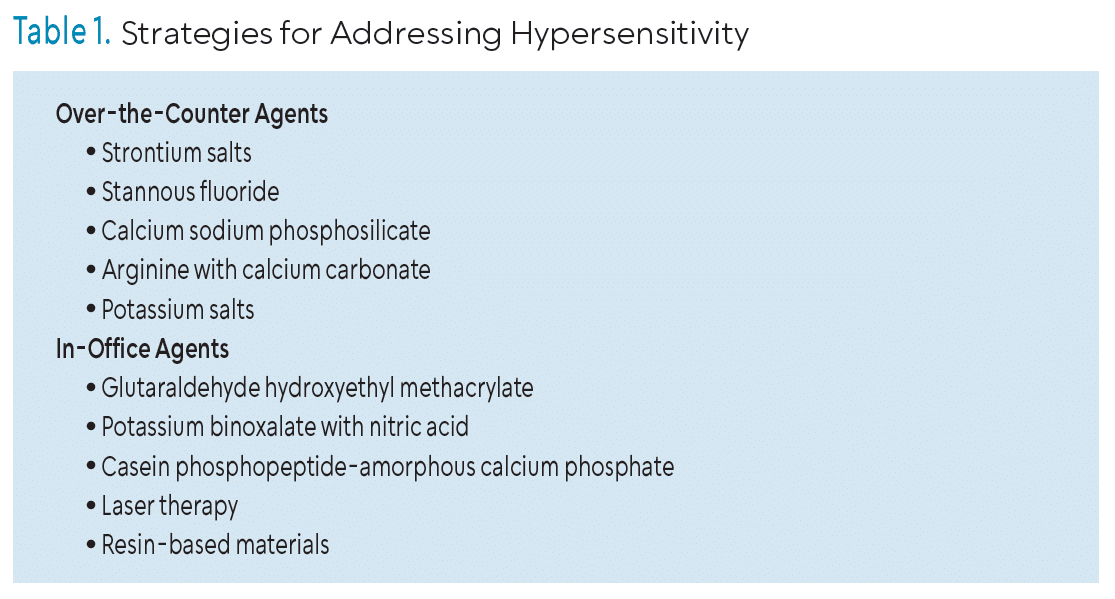
For nonvital teeth, intracoronal whitening is a minimally invasive treatment option. During intracavity bleaching, the bleaching agent acts directly on the dentin structure.8 Stained teeth are treated with hydrogen peroxide, carbamide peroxide, or sodium perborate gels, all of which contain hydrogen peroxide as the active ingredient that whitens the teeth through an oxidation chemical reaction.9 Dentinal hypersensitivity is common with the use of bleaching agents and patients must be advised on how to address it in order for the whitening treatment to be successful (Table 1).
The walking bleach technique, also called the thermocatalytic technique, is a noninvasive approach used to whiten a single, discolored, nonvital tooth. The method involves placing a bleaching agent inside the pulp chamber and sealing it temporarily, allowing the agent to work over several days. In the walking bleach technique, proper root filling and establishment of a cervical seal are crucial. The bleaching agent should be changed every 3 to 7 days. The walking bleach approach often uses a lower concentration of hydrogen peroxide to minimize potential changes to the histological and morphological features of the tooth structure.7
![]() Systematic Review of the Literature
Systematic Review of the Literature
Our systematic review of the literature on the walking bleach technique resulted in a total of 184 patients with an initial number of 194 endodontically treated teeth. Of these, 172 endodontically treated teeth received bleaching as treatment; 69 were treated with hydrogen peroxide, 101 treated with carbamide peroxide, and two treated with sodium perborate.
The mean patient age was 30.54 years with the youngest being 18 and the oldest being 65.1,10 The average follow-up period was 12 months. Hydrogen peroxide (five studies) and carbamide peroxide (four studies) were the most commonly used agents for tooth bleaching among the studies we reviewed.
In all reviewed studies, a clinically significant difference in the whiteness of the treated tooth was reported after delivering the bleaching treatment among all participants regardless of the whitening agent used, their treatment protocols, and assigned groups. However, in the randomized clinical trials, no significant difference in tooth whitening was reported between the two groups.9
Most studies with a follow-up period of less than 2 years reported satisfactory results using their respective bleaching techniques. However, in a contrasting long-term study, Amato et al10 reported six failures out of 40 samples over a 25-year period, resulting in the recurrence of tooth discoloration.
The definition of success varied across the studies. The term used as the clinically significant difference was determined based on the tooth shade change, patient satisfaction, and researcher satisfaction after the bleaching treatment.
Clinical Case
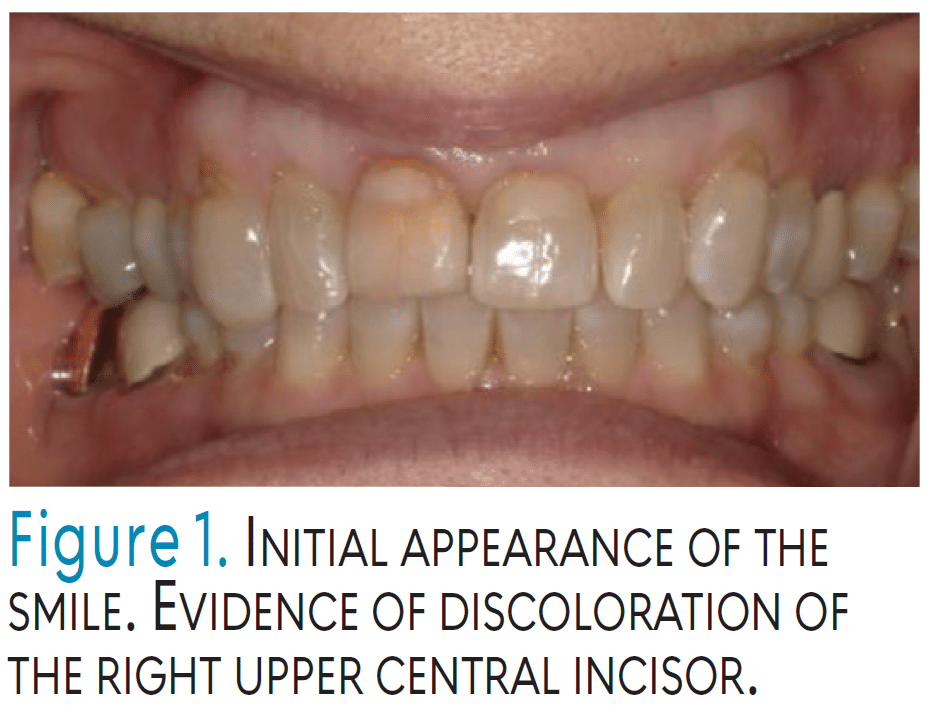
A 63-year-old nonsmoking woman complained about discoloration of her right upper central incisor, tooth #8 (Figure 1). On our examination, we did not note any significant dentin loss in the cervical portion, extensive restorations, or visible cracks.
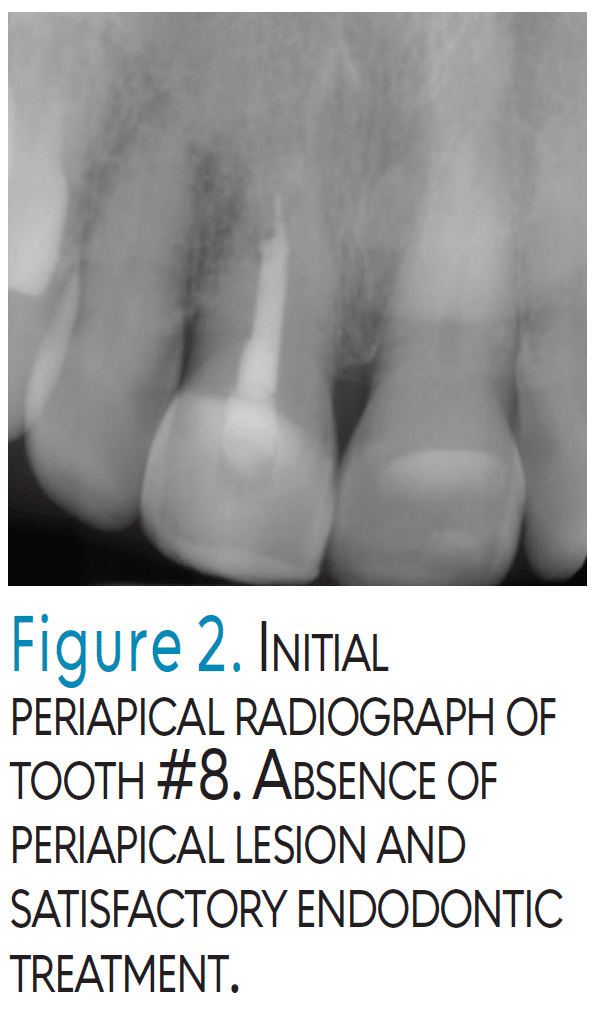
 The patient was given the option of internal bleaching after evaluating the tooth both radiographically and clinically (Figure 2). For the bleaching protocol on tooth #8, a mixture of sodium perborate and articaine was used. During the first visit, we removed the composite from the lingual aspect and filled the access to the cementoenamal junction with glass-ionomer restorative.
 Next, we placed a mixture of sodium perborate and articaine in the chamber and covered it with glass-ionomer material before light-curing it. We scheduled a follow-up appointment for evaluation after 1 week.
On the second visit, we observed that the gray discoloration on the buccal surface of tooth #8 was no longer visible, but yellow discoloration remained. We placed a new mixture of sodium perborate and articaine in the canal and closed its access with glass-ionomer restorative. We scheduled a follow-up appointment for re-evaluation after 1 week.
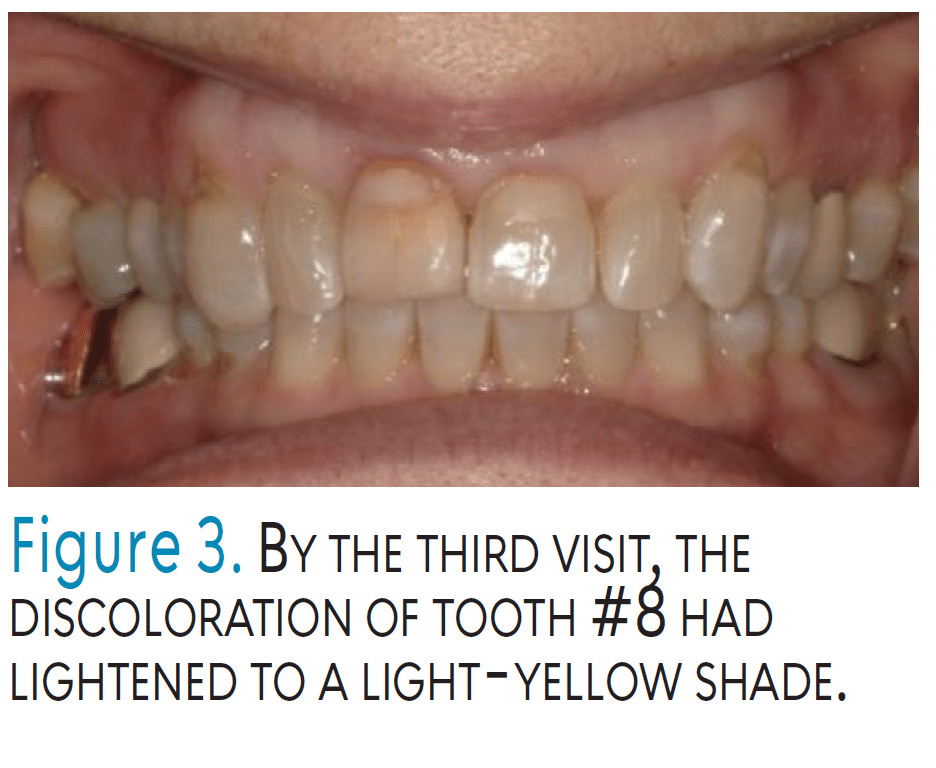
During the third visit, we observed that the discoloration had lightened to a light-yellow shade. The patient expressed satisfaction with the shade change, and we scheduled veneer preparation and possible gingivectomy for the next appointment as the patient was not completely satisfied with the final esthetic outcome (Figure 3).
![]() Discussion
Discussion
The results of our study demonstrated that walking bleaching generally produces satisfactory outcomes in most patients, regardless of the whitening agent and protocol used. The studies revealed varying degrees of shade change after completion of walking bleach treatment, indicating a clinically significant difference before and after treatment. However, shade change doesn’t necessarily reflect patient satisfaction.
When managing discolored teeth, clinicians have several treatment options and combinations at their disposal.5 Factors, such as safety and effectiveness, play vital roles in the clinician’s decision-making process.12
After reviewing eight articles, it became evident that while different etiologic factors do not significantly affect the outcome of walking bleach treatment, other characteristics can impact the final result. For instance, walking bleaching tends to yield better outcomes in younger patients compared to elderly patients.7,13 In the case of older adults, the natural aging process leads to the deposition of secondary dentin, affecting the light-transmitting properties of teeth, resulting in gradual darkening.7 Furthermore, certain root canal sealer materials are less likely to whiten with internal bleaching; however, bleaching can still reduce the intensity of the grayish color.14
Dissatisfaction with the outcome is more common in necrotic teeth and those with discoloration caused by root canal treatment sealer materials compared to other discolored teeth.15
The predictability of the walking bleach result is not completely assured, and it is crucial to consider the expectations of patients. Additionally, the effectiveness and success rate of nonvital bleaching can vary depending on the etiological cause of tooth discoloration.
Our review confirmed that the walking bleach technique tends to yield satisfactory results in most patients, regardless of the bleaching agent and protocol used. Shade change does not necessarily indicate patient satisfaction. The success rates of whitening agents with varying concentrations did not significantly differ. Factors, such as age, tooth condition, and root canal sealer materials, can influence the outcomes of walking bleaching. Longer follow-up periods and the development of protocols for maintaining the bleaching effect are recommended.
References
- Bersezio C, Ledezma P, Estay J, Mayer C, Rivera O, Fernández E. Color regression and maintenance effect of intracoronal whitening on the quality of life: rct—a one-year follow-up study. Oper Dent. 2019;44:24–33.
- Machado AC, Braga SRM, Ferreira D, Jacintho FF, Scaramucci T, Sobral MAP. Bleaching of severely darkened nonvital tooth case report — 48 months clinical control. J Esthet Restor Dent. 2021;33:314–322.
- Kahler B. Present status and future directions – managing discoloured teeth. Int Endod J. 2022;55:922–950.
- Shillingburg HT, Sather DA, Wilson EL, et al. Fundamentals of Fixed Prosthodontics. 3rd ed. Chicago: Quintessence Publishing; 2014.
- Poyser NJ, Kelleher MGD, Briggs PFA. Managing discoloured non-vital teeth: the inside/outside bleaching technique. Dent Update. 2004;31:204–214.
- Joshi SB. An overview of vital teeth bleaching. Journal of Interdisciplinary Dentistry. 2016;6(1):3-13.
- Plotino G, Buono L, Grande NM, Pameijer CH, Somma F. Nonvital tooth bleaching: a review of the literature and clinical procedures. J Endod. 2008;34:394–407.
- Georgieva I. Intracavity tooth bleaching in the aesthetic zone of maxilla using carbamide peroxide gel — case report. Journal of IMAB. 2020;26(3):3223–3225.
- Bersezio C, Vildósola P, Sáez M, et al. Does the use of a “walking bleaching” technique increase bone resorption markers? Oper Dent. 2018;43:250–260.
- Amato A, Caggiano M, Pantaleo G, Amato M. In-office and walking bleach dental treatments on endodontically-treated teeth: 25 years follow-up. Minerva Stomatol. 2018;67:225–230.
- Frank AC, Kanzow P, Rödig T, Wiegand A. Comparison of the bleaching efficacy of different agents used for internal bleaching: a systematic review and meta-analysis. J Endod. 2022;48:171–178.
- Reitzer F, Ehlinger C, Minoux M. A modified inside/outside bleaching technique for nonvital discolored teeth: a case report. Quintessence Int. 2019;50:802–807.
- Knezevic N, Obradovic M, Dolic O, et al. Clinical testing of walking bleach, in-office, and combined bleaching of endodontically treated teeth. Medicina (B Aires). 2022;59:18.
- Yang WC, Tsai LY, Hsu YH, Teng NC, Yang JC, Hsieh SC. Tooth discoloration and the effects of internal bleaching on the novel endodontic filling material SavDen® MTA. J Formos Med Assoc. 2021;120(1 Pt 2):476–482.
- Watts A, Addy M. Tooth discolouration and staining: a review of the literature. Br Dent J. 2001;190:309–316.
From Dimensions of Dental Hygiene. March/April 2026;24(2):22-24