


Where Cancer Care Meets the Mouth
Oral complications of cancer therapy demand a team-based approach and dental hygienists are essential to early detection, prevention, and patient-centered care.
This course was published in the March/April 2026 issue and expires April 2029. The authors have no commercial conflicts of interest to disclose. This 2 credit hour self-study activity is electronically mediated.
AGD Subject Code: 149
EDUCATIONAL OBJECTIVES
After reading this course, the participant should be able to:
- Identify the common oral complications associated with oncology treatments and describe the dental hygienist’s role in managing these conditions across the continuum of care.
- Describe evidence-based strategies for oral health assessment, prevention, and management before, during, and after cancer therapy.
- Discuss the importance of interprofessional collaboration and the expanding role of dental hygienists in oncology care to improve patient outcomes and quality of life.
Oncology treatments, such as chemotherapy and radiation therapy, are essential for combating malignancies but often result in a range of challenging oral side effects. Patients frequently experience complications such as xerostomia, mucositis, and an increased susceptibility to infections.1 In this context, dental hygienists play a crucial role in mitigating these issues through preventive care, education, and collaborative treatment strategies.
Despite their valuable contributions, the expertise of dental hygienists in oncology care is often underutilized. While it is crucial to maintain good oral hygiene for patients with cancer, many oncology providers may not prioritize this critical aspect in their patient management strategies. However, dental hygienists are uniquely positioned to address the oral health needs of this patient population by conducting thorough assessments, providing tailored oral hygiene instructions, and collaborating closely with oncologists and other healthcare professionals. Improved collaboration among dental hygiene practices within oncology healthcare teams leads to improved patient outcomes and fosters a more holistic approach to patient care.1
Oral Health Management Before, During, and After Oncology Treatment
The increasing involvement of dental hygienists in public sectors, such as long-term care facilities, community health centers, and hospitals, positions them to treat more diverse populations with more extensive and complicated medical histories.2 This is particularly important for patients with cancer diagnoses. As the number of new cancer cases continues to rise, research suggests the importance of recognizing cancer risk factors, conducting thorough cancer screenings, and effectively communicating with patients to gather relevant information about their cancer history.1,3
Before a patient can begin oncology treatment, a comprehensive dental evaluation must be performed to establish a healthy baseline. This information is used to monitor a patient’s oral health status. Any necessary dental treatment should then be completed as soon as possible due to impaired healing during oncology treatment.4 During preventive care, dental hygienists can provide nutritional counseling, emphasizing the benefits of a noncarcinogenic diet, educate about the importance of maintaining good oral hygiene habits, include preventive therapies such as fluoride trays for use at home, and offer recommendations on managing oral side effects related to oncology treatments.5
After oncology therapy, a dental hygiene recare interval should be established based on the patient’s assessed risk for recurrent lesions or metastases.4 Therefore, dental hygienists must educate patients about their specific needs before, during, and after treatment. While maintaining the oral cavity may not always be prioritized after oncology treatment, dental hygienists should emphasize the connection between oral health and cancer treatment outcomes to motivate patients to maintain their oral hygiene.2 Incorporating dental hygienists into cancer care can enhance patient management and improve outcomes for those who have undergone oncology treatment.6
Dental hygienists are encouraged to communicate directly with a patient’s oncology team, as they support the patient at every stage of care — from establishing a baseline and maintaining periodontal stability to managing secondary effects.2
Dental Concerns With Oncology Treatment
Oncology treatment exacerbates dental caries and periodontal diseases with a study finding both worsening by 20.8% in patients undergoing cancer treatment.7 Caries progression was evaluated 1 to 2 years post-cancer therapy, revealing worsening of existing lesions and development of new ones in previously unaffected teeth.7
The number of periodontal bacteria is elevated among patients undergoing cancer treatment.7 These bacteria invade oral tissues, enter the bloodstream, and worsen systemic conditions, making them difficult to eliminate.8 Porphyromonas gingivalis, Aggregatibacter actinomycetemcomitans, and Tannerella forsythia are the main bacteria associated with the connection between periodontal diseases and cancer.8
Oral mucositis — painful ulcerations and erythema, which can significantly impede speaking and eating — is also associated with cancer treatment.9 Research shows that laser therapy, professional oral hygiene, antimicrobial agents, and zinc supplementation are the most effective preventive measures.10 Dental hygienists are well-equipped to administer these preventive strategies. Throughout their education, dental hygiene students undergo extensive clinical and didactic training in which they are evaluated on their proficiency in implementing the prevention methods known to prevent oral mucositis.11
Routine dental care remains essential throughout the diagnosis.12 Microorganisms predominantly reside in supra- and subgingival biofilm, serving as a reservoir for acute oral infections.13 These infections can intensify the symptoms and manifestations of oral pathologies (see Table 1).1,3,7,10,14 Dental hygienists play a crucial role in effectively addressing etiological factors to optimize patient outcomes during treatment.13
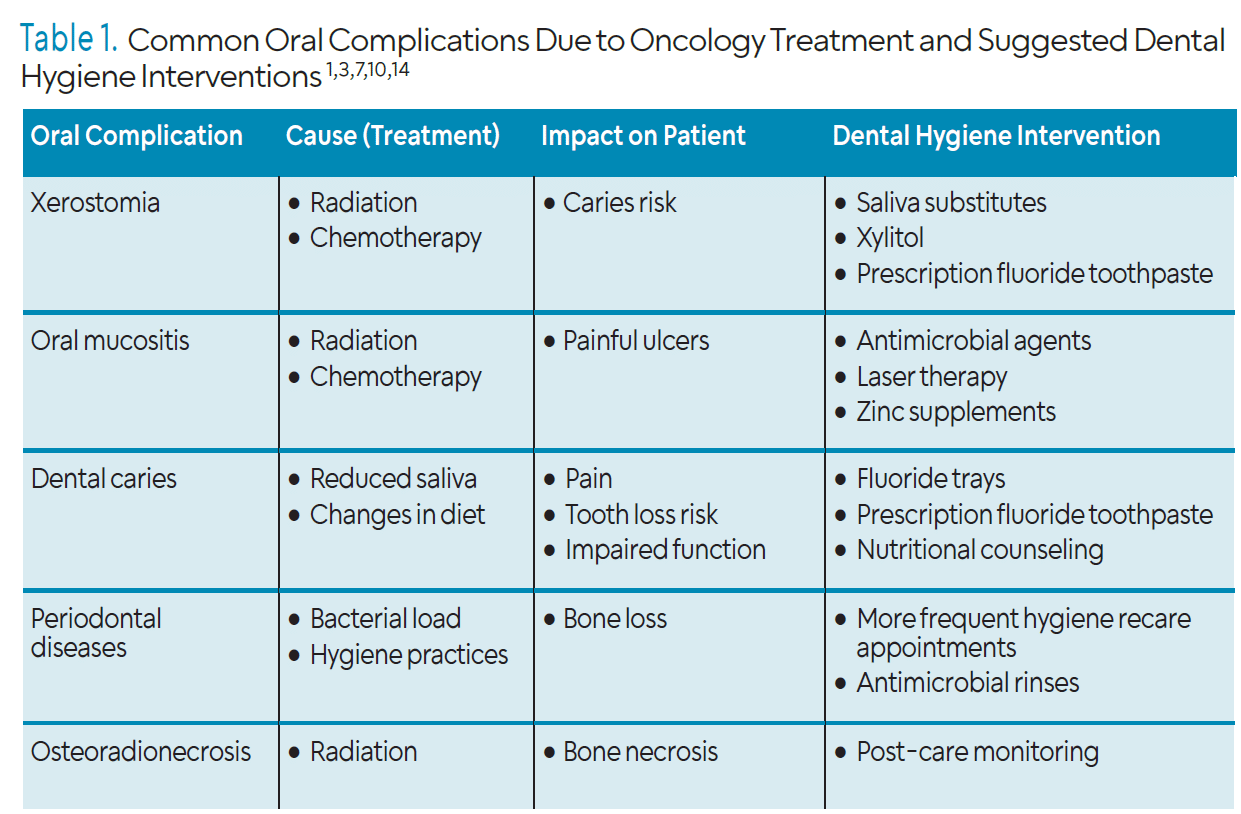
Patients treated with radiotherapy should receive preventive care at least 2 weeks before the beginning of therapy to avoid further complications and to minimize the risk of osteoradionecrosis.15 Osteoradionecrosis, a significant complication for patients undergoing radiation oncology treatment, involves the progressive destruction of bone, most commonly affecting the mandible.14
Oral hygiene is critical to reducing patient discomfort after oncology treatment with an emphasis on implementing relief strategies, making dietary adjustments, and tailoring treatment plans to each patient’s needs.16 Dental hygienists deliver personalized oral hygiene instructions, nutritional counseling, and management recommendations. Utilizing their extensive training, they are able to develop patient-specific treatment strategies, guidelines, and goals. While caring for patients undergoing oncology treatment, dental hygienists will naturally shift toward a more interprofessional position.17
Expanding the Role of Dental Hygienists on Oncology Care Teams
Historically, dental hygienists were primarily viewed as prevention specialists, mainly working in private practices; however, the scope of practice has evolved significantly.18,19 Changes to legislation and professional advocacy have made it easier for dental hygienists to practice in other capacities, such as public health clinics, hospitals, nursing facilities, and rural underserved areas.2,20 With the increase in access to care, more medically complex populations can be treated, including oncology patients.
When observing a patient with cancer as a whole, oral complications from cancer treatment go far beyond physical discomfort. Difficulty eating, speaking, or maintaining oral hygiene may lead to social isolation, anxiety, and diminished self-esteem.21,22 Dental hygienists play a unique role in addressing these emotional and psychological burdens. Their consistent presence, empathetic communication, and personalized guidance offer patients reassurance, comfort, and continuity of care.16,17,23
This humanistic approach complements clinical strategies and underscores why dental hygienists must be integrated into interprofessional oncology teams. As patients navigate complex treatments, collaboration among healthcare providers, including dental hygienists, ensures that both physical and emotional needs are addressed.
Dental hygienists play a crucial role in preparing oncology patients pre- and post-surgery for the impact of cancer therapies on oral health and helping them maintain their quality of life.3 The dental hygienist’s involvement is in the prevention of painful infections and concerns regarding mucositis. Oral hygiene instructions and dental hygiene procedures prior to, during, and after treatment to reduce pathogens are paramount to a patient undergoing oncological treatment, who will be immunocompromised.3
Research shows that the inclusion of dental hygienists in interdisciplinary healthcare for oncology patients is viewed positively. Warren et al24 found that 96% of 100 nursing and dental hygiene students (64 nursing and 36 dental hygiene) expressed a willingness to collaborate with other healthcare professionals, and 99% agreed that shared learning would help them become more effective team members in the management of oncology patients. The authors surmised that enhanced knowledge, proficiency, and willingness to conduct screenings for patients undergoing cancer therapies are better achieved through interprofessional collaboration. Students in both professions expressed a strong desire for collaboration.24
As previously mentioned, periodontal bacteria are increasingly found in oncology patients.7 This finding supports the need for interprofessional collaboration to ensure best patient outcomes. In addition to the patient’s physician, oncologist, and nurse, dental hygienists should be considered valuable members of the patient’s care team.25 However, a lack of knowledge regarding their skill set and gaps in communication between providers have resulted in the underutilization of dental hygienists in multidisciplinary teams.26 Integrating dental hygienists into the interdisciplinary team for oncology patients can further optimize overall health outcomes.3
Oral Health Challenges in Cancer Care: Implications for Dental Hygienists in the Dental Setting
While high-risk bacteria play a significant role in periodontal diagnosis, stringent oral hygiene practices are necessary for the outcome of the patient’s oncology treatment.27 Poor oral hygiene can exacerbate periodontal issues, especially if oncology treatments lead to a decline in a patient’s self-care routine.28,29 Oncology treatment often results in the deterioration of effective oral hygiene habits, making it even more essential for patients to consult with oral health professionals.23 Dental hygienists provide strategies to manage oral health routines and reduce bacterial levels through preventive services.30,31
Dental hygienists can strengthen interprofessional collaboration by reinforcing dietary recommendations made by the nutritionist, emphasizing those that alleviate the oral effects of oncology treatments. This partnership creates a comprehensive approach to patient care.32
Dental hygienists are exposed to a wide range of patient populations in their practice. By staying current through continuing education courses, dental hygienists are qualified to manage the evolving landscape of oral health complications associated with oncology treatment. A more collaborative, interprofessional approach to care can be achieved by increasing referrals and integrating dental hygienists into settings, such as hospitals, ultimately improving patient outcomes. Interprofessional collaboration and the integration of dental hygienists into oncology care are crucial.33
Call to Action to Broaden the Impact of Dental Hygienists
To incorporate dental hygienists into these expanded roles, interprofessional relationships must be built at the local level — in hospitals with nutritionists and oncology teams. Through community advocacy, educational seminars, and collaboration, dental hygienists can highlight the value of their profession in oropharyngeal cancer prevention and oncology care.1,2
These efforts can ensure that dental hygienists are fully integrated into broader healthcare conversations and opportunities as an integral part of the healthcare team. By interprofessional collaboration, dental hygienists will elevate the profession, engage in meaningful dialogue, and improve patient outcomes through integrated, team-based care.1 Dental hygienists can advocate for their inclusion in oncology teams by initiating collaboration, pursuing continuing education in oncology care, and educating patients and providers about their role.
Conclusion
Cancer treatments, such as chemotherapy and radiation often display manifestations in the oral cavity.1 To effectively manage these effects, a collaborative care team must be assembled, incorporating various healthcare professionals.34 Dental hygienists are specifically trained to identify cancer risk factors, conduct oral cancer screenings, provide preventive services, offer patient-specific oral hygiene instructions, and manage potential oral side effects associated with cancer therapies.11
Unfortunately, dental hygienists are frequently underutilized in these settings, despite possessing many qualifications that make them highly capable. Ultimately, the goal of all healthcare professionals is to deliver the most effective, patient-centered care possible, tailored to the specific needs and goals of each individual. To close gaps in oncology care, dental hygienists must be fully integrated into the care team.
References
- National Cancer Institute. Oral Complications of Cancer Therapies (PDQ®)–Patient Version. Available at cancer.gov/about-cancer/treatment/side-effects/mouth-throat/oral-complications-pdq#_29. Accessed February 3, 2026.
- Dsouza-Norwood R, Kornegay E. Managing patients undergoing cancer therapy. Dimensions of Dental Hygiene. 2021;19(11):36–39.
- Lanzetti J, Finotti F, Savarino M, Gassino G, Dell’Acqua A, Erovigni F. Management of oral hygiene in head-neck cancer patients undergoing oncological surgery and radiotherapy: A systematic review. Dent J. 2023;11:83.
- Yong C, Robinson A, Hong C. Dental evaluation prior to cancer therapy. Front Oral Health. 2022;3:876941.
- Williams K. Impact of diet on oral health. Dimensions of Dental Hygiene. 2020;18(4):34–37.
- Matsuda Y, Karino M, Okuma S, Ikebuchi K, Takeda M, Kanno T. Proposal of dental hygiene diagnosis for cancer patients based on dental hygiene process of care in acute care hospitals: A narrative review. Healthcare (Basel). 2020;8:217.
- Soutome S, Otsuru M, Kawashita Y, Funahara M, Ukai T, Saito T. Effect of cancer treatment on the worsening of periodontal disease and dental caries: A preliminary, retrospective study. Oral Health Prev Dent. 2021;19:399–404.
- Zhou Y, Meyle J, Groeger S. Periodontal pathogens and cancer development. Periodontol 2000, 2024;96:112–149.
- Bell A, Kasi A. Oral mucositis. Available at ncbi.nlm.nih.gov/books/NBK565848. Accessed February 3, 2026.
- Daugėlaitė G, Užkuraitytė K, Jagelavičienė E, Filipauskas A. Prevention and treatment of chemotherapy and radiotherapy induced oral mucositis. Med (Kaunas). 2019;55:25.
- American Dental Education Association. ADEA Compendium of Curriculum Guidelines (Revised edition). Available at csi.edu/_files/pdf/health-science-human-service-department/dental-hygiene/dental-hygiene-program-adea-compendium-guidelines.pdf. Accessed February 3, 2026.
- American Dental Association. Cancer Therapies and Dental Considerations. Available at ada.org/resources/ada-library/oral-health-topics/cancer-therapies-and-dental-considerations. Accessed February 3, 2026.
- Kusiak A, Jereczek-Fossa B, Cichońska D, Alterio D. Oncological-therapy related oral mucositis as an interdisciplinary problem-Literature review. Int J Environ Res Public Health. 2020;17:2464.
- Naseer A, Brennan S, MacCarthy D, O’Connell J, O’Sullivan E, Leech M. Prevention of osteoradionecrosis in patients with head and neck cancer treated with radiation therapy. Head Neck. 2024;47:472–484.
- Saunders D, Koyfman S, Ismaila N, et al. Prevention and management of osteoradionecrosis in patients with head and neck cancer treated with radiation therapy: ISOO-MASCC-ASCO guideline clinical insights. JCO Oncol Pract. 2024;20:1571–1574.
- Hong C, Gueiros L, Fulton J, et al. Systematic review of basic oral care for the management of oral mucositis in cancer patients and clinical practice guidelines. Support Care Cancer. 2019;27:3949–967.
- Winter I, Ingledew P, Golden D. Interprofessional education in radiation oncology. J Am Coll Radiol. 2019;16:964–971.
- Fones A. The origin and history of the dental hygienists. J Dent Hyg. 2013;87(Suppl 1):58–62.
- American Dental Hygienists’ Association. Dental hygiene Practice Act Overview. Available at .adha.org/wp-content/uploads/2024/09/Practice-Act-Overview-9-2024.pdf. Accessed February 3, 2026.
- American Dental Hygienists’ Association. Direct Access States. Available at adha.org/wp-content/uploads/2023/03/ADHA_Direct_Access_Chart_2022-08-1.pdf. Accessed February 3, 2026.
- Hajek A, König HH. The association between oral health-related quality of life, loneliness, perceived and objective social isolation-results of a nationally representative survey. Int J Environ Res Public Health. 2021;18:12886.
- Abdullah A, König HH, Hajek A. Oral health-related quality of life and loneliness: results based on a cross-sectional survey. Arch Public Health. 2024;82:114.
- Qamar S, Rozi S, Sawani S, et al. Oral health related quality of life in head and neck cancer survivors within the first year following treatment: A cross-sectional study in Karachi, Pakistan. Sci Rep. 2024;14:2560.
- Warren D, Stanek J, Dsouza R, Ciarrocca K, Brame J. Interprofessional collaboration among dental hygiene and nursing students on the oral health of cancer patients. Nurs Educ Perspect. 2022;43:E85–87.
- Theile C, Strauss S, Northridge M, Birenz S. The oral healthcare manager in a patient-centered health facility. J Evid Based Dent Pract. 2016;16(Suppl):34–42.
- Imafuku R, Nagatani Y, Yamada S. Complexities of interprofessional identity formation in dental hygienists: An exploratory case study. BMC Med Educ. 2022;22:8.
- Rapone B, Nardi G, Venere D, Pettini F, Grassi F, Corsalini M. Oral hygiene in patients with oral cancer undergoing chemotherapy and/or radiotherapy after prosthesis rehabilitation: protocol proposal. Oral Implantol (Rome). 2017;9:90–97.
- Nicolae F, Bennardo F, Barone S, Șurlin P, Gheorghe D, Burtea D, et al. The need for oral hygiene care and periodontal status among hospitalized gastric cancer patients. J Pers Med. 2022;12:684.
- Lertpimonchai A, Rattanasiri S, Vallibhakara SO, Attia J, Thakkinstian A. The association between oral hygiene and periodontitis: A systematic review and meta-analysis. Int Dent J. 2020;67:332–343.
- Ishikawa A, Yoneyama T, Hirota K, Miyake Y, Miyatake K. Professional oral health care reduces the number of oropharyngeal bacteria. J Dent Res. 2008;87:594–598.
- Chhaliyil P, Fischer K, Schoel B, Chhalliyil P. A novel, simple, frequent oral cleaning method reduces damaging bacteria in the dental microbiota. J Int Soc Prev Community Dent. 2020;10:511–519.
- Kaye J, Lee S, Chinn C. The need for effective interprofessional collaboration between nutrition and dentistry. Front Public Health. 2025;13:1534525.
- Prasad M, Manjunath C, Murthy A, Sampath A, Jaiswal S, Mohapatra A. Integration of oral health into primary health care: A systematic review. J Family Med Prim Care. 2019;8:1838–1845.
- Luu T. Cancer patient management: role of multidisciplinary teams. BMJ Support Palliat Care. 2022;12:201–206.
From Dimensions of Dental Hygiene. March/April 2026;24(2):32-35