

Arresting Caries With Silver Diamine Fluoride
This formulation offers a wide array of benefits, making it valuable in both traditional and community-based settings.
Silver diamine fluoride (SDF) is a minimally invasive, caries-arresting agent that offers both antibacterial and remineralizing benefits.1 First introduced in Japan in 1970,2 38% SDF received clearance by the United States Food and Drug Administration (FDA) in 2014 for the treatment of dentinal hypersensitivity. The FDA designates SDF as a Class II medical device, cleared for professional application in managing dentinal hypersensitivity (similar to the regulatory classification of fluoride varnish). Two FDA-cleared SDF products are currently available for dental use in the US.3
Numerous studies have documented SDF’s effectiveness in arresting dental caries, and its use for caries prevention and treatment is an accepted off-label application.4 SDF’s minimally invasive nature, broad applicability, and painless, anesthesia-free application make it suitable for patients across the lifespan.
Its quick application reduces chair time and is cost-effective.5 As SDF use grows, dental hygienists need scope-appropriate guidance on indications, contraindications, workflow integration, documentation, and patient communication.
SDF is available in either a liquid or a gel that contains three essential components: silver, fluoride, and ammonia. Silver provides antimicrobial action by disrupting bacterial cell walls and interfering with the enzymatic process. Fluoride supports remineralization and caries prevention by forming fluorapatite, increasing tooth resistance to demineralization. Ammonia stabilizes the solution and helps silver and fluoride ions penetrate tooth structure.6
Upon application, SDF penetrates up to 20 µm into sound enamel and even deeper into dentin. Its high alkalinity favors crystal formation, supporting remineralization.2 Silver ions form silver salts and silver nitrate within the tooth structure, which contribute to increased acid resistance and formation of calcified dentin.7 Together, these actions create a robust cariostatic effect that not only arrests active lesions but also helps prevent new lesion development.8
Understanding this mechanism of action is key to making evidence-based decisions about when SDF is clinically appropriate. For example, SDF’s tubule-sealing action can significantly reduce sensitivity, making it a valuable adjunct in nonsurgical periodontal therapy.6,7 Similarly, patients at high-caries risk will benefit from SDF’s role in controlling disease.7
Safety Considerations and Contraindications
SDF has demonstrated a strong safety profile, but clinicians should be familiar with appropriate dosing and contraindications. One drop (0.05 mL) of SDF contains about 2.24 mg of fluoride, less than many unit-dose fluoride varnish applications. The silver content per drop is approximately 4.74 mg.8 Dosing guidelines recommend no more than one drop per 10 kg (approximately 22 lbs) of body weight, allowing treatment of five to six teeth per appointment.9 For example, a child weighing about 44 lbs (20 kg) would have a maximum recommended dose of two drops. Although this exceeds the US Environmental Protection Agency’s recommended lifetime cumulative daily silver intake, it remains well below known toxicity thresholds.8
Absolute contraindications include a known silver allergy. SDF should be avoided in individuals with ulcerative gingivitis or stomatitis, teeth associated with spontaneous pain or active pulpal pathology, and lesions with exposed pulp tissue. Some patients may also report a metallic taste. Soft-tissue contact may cause temporary irritation or staining that typically resolves in 48 hours, which emphasizes the importance of isolation to protect tissues and minimize unintended staining.6
Scope of Practice and Regulatory Considerations
The scope of practice for SDF application varies widely by state, so regulatory awareness is essential. Depending on the state, dental hygienists may apply SDF under direct, indirect, or general or public health supervision, limited-access permits, or teledentistry-enabled models.8.9 In some states with expanded practice authority or collaborative agreements, dental hygienists may apply SDF independently as part of preventive or therapeutic care.9 The American Dental Hygienists’ Association provides a state-specific handout about SDF authorization, including supervision level, practice setting, and any special permits or collaborative requirements.9
Indications for Use
SDF has broad, evidence-based indications that make it especially valuable across multiple patient populations. Research shows that SDF is more effective than sodium fluoride varnish for arresting early childhood caries (ECC) and is successful on both anterior and posterior lesions.6,10 It is particularly helpful when patients have multiple cavitated lesions requiring phased treatment over multiple visits.5
SDF is particularly beneficial for children with ECC who are unable to tolerate traditional restorative procedures, and for those treated in school-based or public health programs where access to professional dental care is limited.10 SDF is equally useful for special-needs or medically compromised patients, including individuals with sensory challenges or behavioral barriers, patients undergoing medical treatments that complicate conventional restorative care, and those with chronic diseases.
SDF provides an accessible option for older adults experiencing root caries associated with recession or xerostomia, and residents of long-term care facilities who are at high risk for caries progression.11 Additionally, SDF serves important roles in periodontal and preventive care. It can be used as a desensitizing agent during or following scaling and root planing, and it functions as a therapeutic measure to stabilize lesions until restorative treatment becomes available.2,11
Communication, Consent, and Expectations
Transparent communication is essential when using SDF, particularly because its primary drawback is dark staining of arrested carious lesions. The dental hygienist should explain why SDF is recommended, its purpose and benefits, and potential adverse effects, including soft tissue irritation and permanent black staining of affected dentin. Patients should also understand that SDF does not stain healthy enamel.
Informed consent should specify tooth numbers and surfaces, expected staining, and follow-up recommendations. Parents/caregivers often accept SDF on posterior teeth where staining is less visible, but may hesitate when anterior esthetics are involved.5 Dental hygienists should be prepared to discuss restorative or esthetic options, including composite restoration or other cosmetic approaches, when a patient desires improvement in the appearance of SDF-stained teeth.
Clinical Application and Documentation
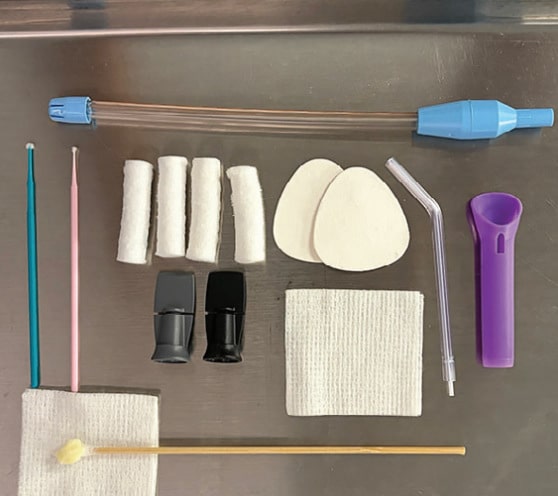
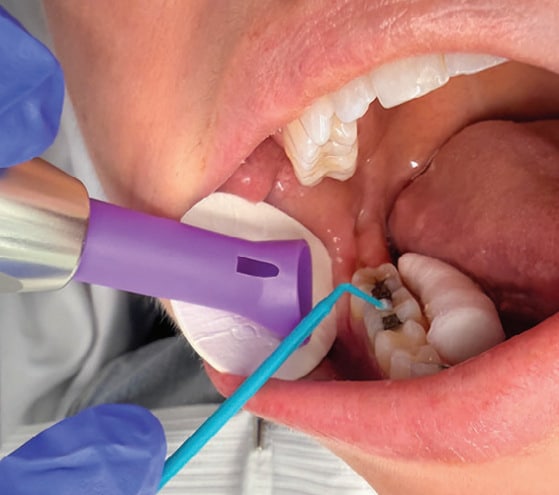
A typical SDF application involves the following steps (Figures 1 and 2):
- Isolate the treatment area with cotton rolls or a rubber dam to protect soft tissues.
- Dispense SDF into a plastic dappen dish (avoid metal and glass due to corrosion).
- Dry the tooth thoroughly to ensure optimal penetration.
- Apply SDF with a microbrush and allow it to absorb for at least 1 minute.
- Blot excess SDF from the tooth surface with gauze or cotton to restrict SDF from contacting soft tissue and causing unintended staining.
- Advise the patient to avoid eating and drinking for at least 30 minutes.5
A successfully arrested lesion typically appears hard and darkened on reevaluation; any accidental gingival staining is usually temporary and fades over time.9 Clinicians should follow manufacturer instructions and clinical judgment in assessing treatment response.
Thorough documentation should include the concentration of SDF used, dosage, treated teeth and surfaces, informed consent, patient education provided, and follow-up recommendations. Further, sites should be reassessed at recare appointments to determine whether reapplication or restorative treatment is needed. SDF does not replace routine dental visits, oral hygiene instruction, or dietary counseling.6
Conclusion
SDF is an important facet of minimally invasive therapy that aligns with preventive, therapeutic, and educational responsibilities of dental hygienists. It arrests caries, manages sensitivity, and improves access to care, making it valuable in both traditional and community-based settings. Ongoing professional education and awareness of state-specific regulations will enable dental hygienists to use SDF effectively.
References
- Mei ML, Zhao IS, Ito L, et al. Prevention of secondary caries by silver diamine fluoride. Int Dent J. 2016;66:71-77.
- El-Damanhoury H, Rahman B, Sheela S, Ngo H. Dentinal tubule occlusion and dentin permeability efficacy of silver diamine fluoride solutions. Int J Dent Hyg. 2025;23:286-293.
- United States Food and Drug Administration. Premarket Notification (510k) Database: Advantage Arrest Silver Diamine Fluoride 38%. Available at accessdata.fda.gov/scripts/cdrh/cfdocs/cfpmn/pmn.cfm?id=K102973. Accessed October 6, 2026.
- Crystal YO, Niederman R. Evidence-based dentistry update on silver diamine fluoride. Dent Clin North Am. 2019;63:45-68.
- Vasanthi D, Saraswathi K, Vinod B, Alam MK, Muralidhar MVP. Silver diamine fluoride – the magic bullet! Is it really a magic alternative in caries management. Bangladesh J Med Sci. 2024;23:993-998.
- Brar A, Singh AP, Narad C, Singh R. The role of silver diamine fluoride in contemporary dental practice: a comprehensive review. J Pharm Bioallied Sci. 2024;16:S1953-S1955.
- Jaradat M, Kolker J, Owais A, et al. Silver diamine fluoride effectiveness in arresting initial approximal caries lesions in adults: A triple-blinded, randomized controlled clinical trial. J Conserv Dent. 2025;28:892
- Jamal D, AlMushayt A, Abujamel T, Bamashmous S, Bamashmous N, Alamoudi N. Silver diamine fluoride: the science behind the action — a narrative review. BMC Oral Health. 2025;25(1):1195.
- American Dental Hygienists’ Association. State Specific Information on Silver Diamine Fluoride. Available at adha.org/wp-content/uploads/2026/01/ADHA_SDF_9.19_Update.pdf. Accessed October 13, 2026.
- Daimary A, Verma RK, Mirza LF, et al. Evaluation of effectiveness of silver diamine fluoride in arresting early childhood caries: A prospective study. J Pharm Bioallied Sci. 2025;17:S2469-S2471.
- Chibinski AC, Wambier LM, Feltrin J, Loguercio AD, Wambier DS, Reis A. Silver diamine fluoride versus sodium fluoride varnish in the arrest of dentin caries in preschool children. Pediatr Dent. 2017;39:E1-E7.
From Dimensions of Dental Hygiene. November/December 2026; 24(6):22-23