

Dental Unit Waterline Management Is Not Optional
Dental practices must treat DUWL management as a measurable infection-prevention and quality-assurance process.
For decades, dental unit waterline (DUWL) management has existed in a space between recommendation and enforcement, contributing to variability in implementation across dental practices. Concerns regarding biofilm formation and microbial contamination in DUWLs have been documented extensively in dental literature, and organizations, such as the United States Centers for Disease Control and Prevention (CDC) and American Dental Association (ADA), have issued guidance aimed at reducing exposure risks for patients and oral health professionals alike.1 Despite longstanding recommendations for waterline treatment and monitoring, adherence to preventive protocols has not been uniform across clinical settings.2 This ambiguity is now diminishing. Emerging state-level regulations requiring documented testing, remediation, and verification are transforming DUWL oversight from an advisory infection-prevention recommendation into a verifiable compliance expectation. Recent regulatory actions in Georgia and Washington state illustrate this shift toward enforceable accountability. In both states, dental practices are required to perform routine DUWL testing, initiate corrective action when microbial thresholds are exceeded, and maintain records for inspection purposes.3,4
Although currently limited to a small number of states, including California, these regulations are likely to serve as a model for broader national adoption. These developments coincide with heightened awareness of waterborne pathogen outbreaks, increased scrutiny of infection prevention programs, and growing expectations for documentation-based verification. The Association for Dental Safety (ADS; formerly OSAP) reinforced these priorities in its 2018 white paper, emphasizing that water quality monitoring, documentation, and verification are essential components of an effective DUWL management program.5
Why Dental Unit Waterlines Require Oversight
DUWLs are uniquely susceptible to microbial contamination due to narrow tubing, low flow rates, and frequent periods of water stagnation. These conditions promote the formation of biofilm, a structured microbial community encased within a protective extracellular matrix that adheres to moist surfaces and resists routine flushing.6
Water clarity is not a reliable indicator of microbial safety. DUWL biofilm may harbor opportunistic pathogens, such as Legionella spp., Pseudomonas aeruginosa, and nontuberculous mycobacterium, organisms associated with healthcare-related infections.6 Importantly, DUWL contamination is often not visible; water that appears clear and odorless may still exceed recommended microbial thresholds.7
The CDC recommends that water used for nonsurgical dental procedures meet the Environmental Protection Agency (EPA) drinking water standard of ≤ 500 CFU/mL of heterotrophic water bacteria.7 Current ADA guidance similarly emphasizes maintaining dental treatment water at or below the EPA drinking water standard through routine treatment, monitoring, and documentation.8
Despite longstanding guidance, maintaining compliant DUWL water quality remains challenging. Research has demonstrated that established biofilms can persist despite intermittent flushing and periodic shock treatments, creating the potential for rapid recolonization when continuous maintenance protocols are not consistently implemented.5,8
The gap between guidance and regulatory oversight became increasingly untenable following several highly publicized outbreaks linked to contaminated dental water systems. In 2022, the CDC issued a Health Alert Network advisory following pediatric infections associated with contaminated dental treatment water during pulpotomy procedures.9-11 This alert reinforced the importance of routine waterline disinfection, continuous monitoring and documentation, and strict adherence to manufacturer instructions for use as foundational components of a comprehensive DUWL management program.9,12
In response, state dental boards have begun codifying DUWL requirements into enforceable regulations. Georgia’s Rule 150-8-.05 mandates quarterly testing and retention of records for 5 years, while Washington state’s WAC 246-817-660 requires routine testing and remediation to confirm acceptable water quality.3,4 Together, these regulations signal a transition from recommendation to enforceable expectation.
Testing Does Not Eliminate Biofilm, It Verifies Control
A critical distinction in DUWL management is recognizing that testing is not the intervention, but rather the mechanism used to verify whether maintenance protocols effectively control biofilm.6 Reliance on testing alone, without continuous antimicrobial maintenance, may create a false sense of safety.
Historically, many dental practices relied on independent water bottle systems combined with periodic shock treatments, sometimes with limited monitoring. However, CDC guidance and the ADS White Paper emphasize that independent reservoirs alone do not ensure acceptable water quality and must be combined with validated treatment methods, routine monitoring, documentation, and adherence to manufacturer instructions to achieve sustained biofilm control.5,7
DUWL management requires a clear distinction between maintenance and remediation. Maintenance involves continuous low-level antimicrobial treatment designed to suppress biofilm development during routine clinical use. Remediation refers to implementation of a shock-treatment protocol following unacceptable microbial test results. Without continuous maintenance and verification testing, biofilm can rapidly recolonize the system following remediation. 5,8
As regulatory expectations evolve, DUWL oversight is best understood as a quality assurance model comparable to sterilization monitoring. Effective compliance requires integration of multiple interdependent components (Figure 1).
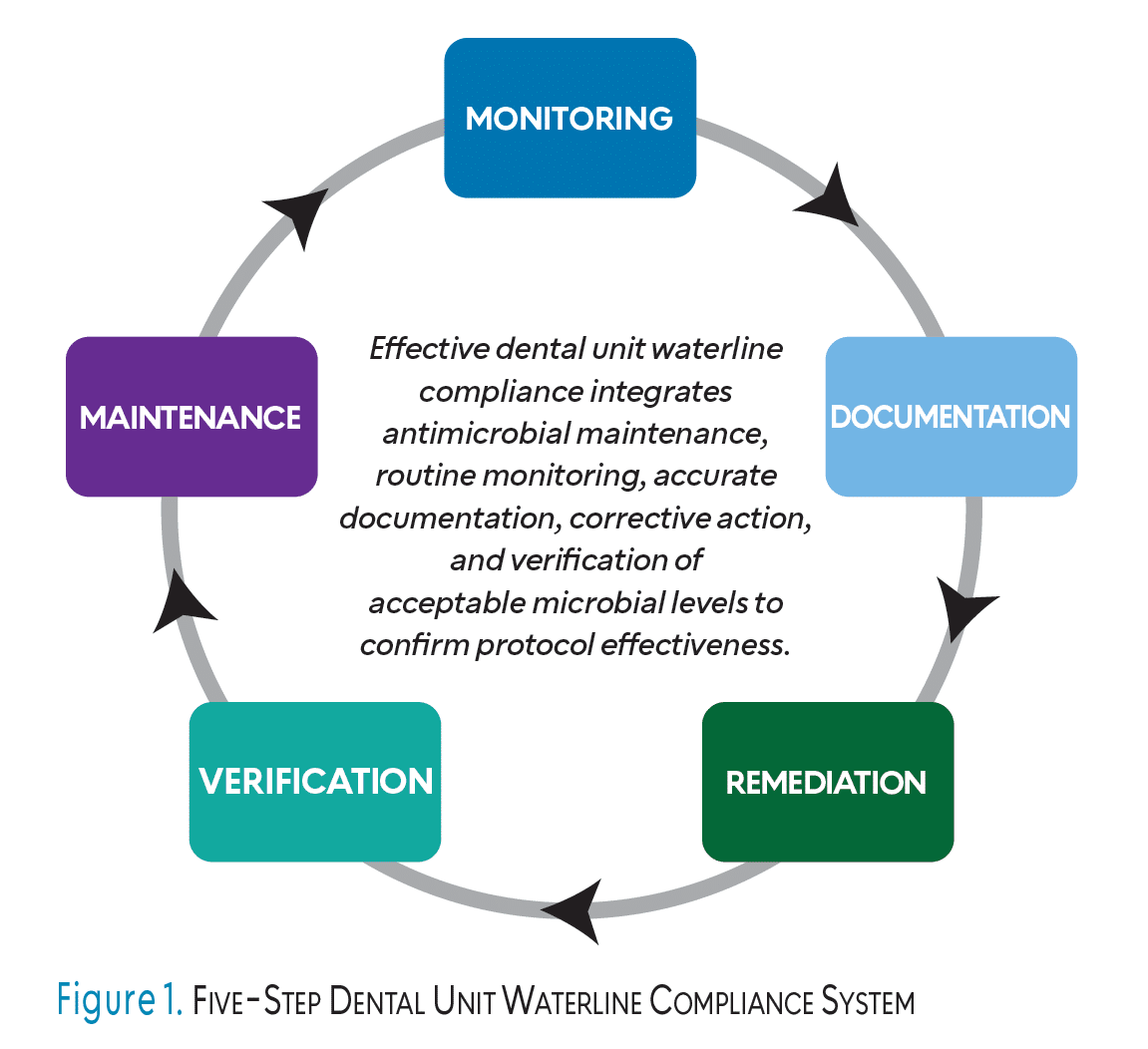 Effective DUWL compliance follows a continuous cycle of antimicrobial maintenance, routine monitoring, documentation, corrective action when indicated, and verification testing before returning units to service.
Verification, defined as documented confirmation that microbial counts have returned to acceptable levels, is the essential final step before clinical use resumes.6,8 This model emphasizes that remediation alone is insufficient; verification is required to align DUWL management with established healthcare quality assurance frameworks.
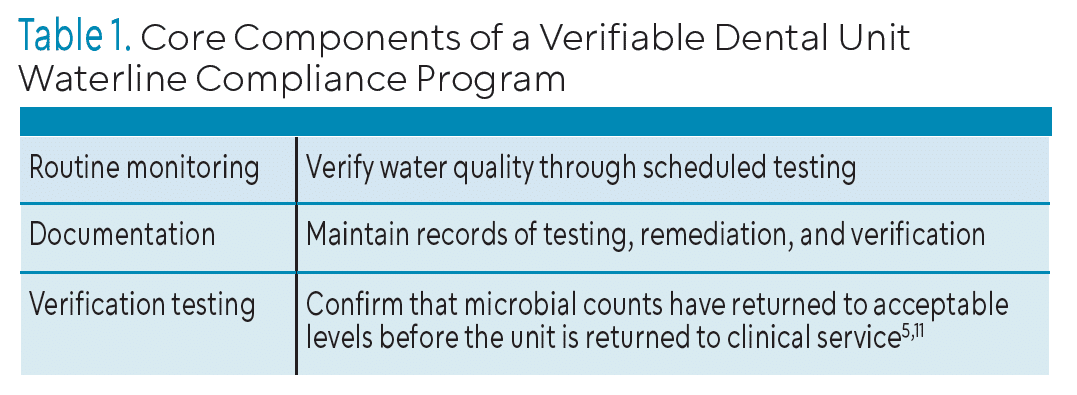
Table 1 illustrates what is needed to meet current and emerging regulatory expectations.5,12 Together, these elements transform DUWL management from a task-oriented activity into a defensible, inspection-ready quality assurance system.
![]() Dental Hygienist’s Role
Dental Hygienist’s Role
Human factors including workflow pressures, insufficient training, unclear delegation, and inconsistent documentation have been identified as barriers to effective DUWL infection-control implementation. Recent survey data demonstrated substantial knowledge and practice gaps regarding testing requirements, documentation procedures, and corrective actions following failed water-quality tests, despite widespread recognition of the importance of DUWL infection prevention.2
Dental hygienists are particularly well positioned to lead DUWL quality assurance efforts because accredited dental hygiene curricula include extensive education in microbiology, infection prevention, patient safety, and quality assurance principles. Commission on Dental Accreditation standards require programs to prepare graduates who are competent in infection prevention and control practices, providing a strong foundation for leadership in DUWL compliance initiatives.13
Conclusion
The trajectory of DUWL oversight is clear: what was once a recommendation is rapidly becoming a regulated standard of care. Mandates for testing, documentation, remediation, and verification reflect a broader shift toward measurable infection-prevention outcomes. For oral health professionals, particularly dental hygienists, this transition presents both a responsibility and an opportunity. As practices adapt to increasing regulatory expectations, dental hygienists are well suited to assume expanded leadership roles in infection prevention, quality assurance, staff training, and compliance oversight.
Practices that adopt structured quality assurance programs will be better positioned to meet evolving expectations while strengthening patient trust. Biofilm management is no longer limited to flushing lines; it now requires systems that are measurable, defensible, and verifiable.
References
- United States Centers for Disease Control and Prevention. Guidelines for Infection Control in Dental Health-Care Settings—2003. MMWR Recomm Rep. 2003;52(RR-17):1-6.
- Vinh R, Azzolin KA, Stream SE, et al. Dental unit waterline infection control practice and knowledge gaps. J Am Dent Assoc. 2024;155:515-525.
- Georgia Board of Dentistry. Dental Unit Water Quality. Rule 150-8-.05. Available at: https://rules.sos.georgia.gov/gac/150-8-.05. Accessed August 22, 2026.
- Washington State Dental Quality Assurance Commission. Dental Unit Water Quality. WAC 246-817-660. Available at: https://app.leg.wa.gov/wac/default.aspx?cite=246-817-660 Accessed August 22, 2026.
- Mills SE, Porteous N, Zawada J, eds. Dental unit water quality: Organization for Safety, Asepsis and Prevention white paper and recommendations—2018. Available at https://osapjdics.scholasticahq.com/article/5075-dental-unit-water-quality-organization-for-safety-asepsis-and-prevention-white-paper-and-recommendations-2018. Accessed August 22, 2026.
- Spagnolo AM, Sartini M, Cristina ML. Microbial contamination of dental unit waterlines and potential risk of infection: a narrative review. Pathogens. 2020;9:651.
- US Centers for Disease Control and Prevention. Dental Unit Water Quality. Available at cdc.gov/dental-infection-control/hcp/summary/dental-unit-water-quality.html Accessed August 22, 2026.
- American Dental Association. Dental Unit Waterlines. Available at ada.org/resources/ada-library/oral-health-topics/dental-unit-waterlines. Accessed August 22, 2026.
- US Centers for Disease Control and Prevention. Health Alert Network (HAN) No. 00478: Dental Infections Associated with Contaminated Water Systems. Available at https://emergency.cdc.gov/han/2022/han00478.asp. Accessed August 22, 2026.
- Peralta G, Tobin-D’Angelo M, Parham A, et al. Notes from the field: Mycobacterium abscessus infections among patients of a pediatric dentistry practice—Georgia, 2015. MMWR Morb Mortal Wkly Rep. 2016;65(13):355–356.
- Castellano Realpe OJ, Gutiérrez JC, Sierra DA, et al. Dental unit waterlines contaminated with nontuberculous mycobacteria: a potential health risk. Int J Environ Res Public Health. 2020;17:2348.
- US Centers for Disease Control and Prevention. Best Practices for Dental Unit Water Quality. Available at cdc.gov/dental-infection-control/hcp/dental-ipc-faqs/best-practices-dental-unit-water-quality.html Accessed August 22, 2026.
- Commission on Dental Accreditation. Accreditation Standards for Dental Hygiene Education Programs. Available at https://coda.ada.org. Accessed August 22, 2026.
From Dimensions of Dental Hygiene. September/October 2026; 24(5):16-18