Rethinking Biofilm Removal Around Dental Implants
Subgingival air polishing with low-abrasive powders can complement mechanical instrumentation by disrupting challenging biofilm while supporting patient comfort and peri-implant tissue health.
Dental implants are an effective option for replacing missing teeth, with long-term success rates exceeding 90% and millions placed worldwide each year.1,2 Despite favorable outcomes in implant placement and long-term preservation of alveolar bone, maintenance is essential for preserving peri-implant tissues and osseointegration, and preventing biological complications. A majority of peri-implant mucositis and peri-implantitis cases are plaque-induced inflammatory conditions that may compromise implant success if left untreated.3 Systematic reviews report the prevalence of peri-implant mucositis at 43% to 46.8% and peri-implantitis at 19.8% to 22%, underscoring the importance of vigilant implant maintenance as a key component of successful implant therapy.2
Implant maintenance requires routine clinical evaluations, patient education, self-care education and reinforcement, professional biofilm and calculus removal to support peri-implant tissue health, and ongoing management of risk factors. Routine clinical evaluations include visual inspection of peri-implant tissues; periodontal probing to assess pocket depths, suppuration, and bleeding; and radiographic evaluation of crestal bone levels and osseointegration.4 In addition, implant maintenance visits involve reviewing self-care routines of patients, the effectiveness of oral hygiene tools recommended, counseling on modifiable risk factors, and performing professional debridement using implant-safe instruments.
While the importance of professional care is well-established, variability exists in clinical approaches and mechanical plaque control techniques for the prevention and management of peri-implant mucositis. The inconsistency in clinical implant maintenance standards highlights the need to identify and validate evidence-based professional approaches to implant care.5 Subgingival air polishing has emerged as a promising adjunctive technique for managing biofilm around implants with minimal surface alteration.6
Benefits of Subgingival Air Polishing with Mechanical Instrumentation
Oral biofilm is widely recognized as the primary etiologic factor in the development of gingivitis, periodontitis, peri-implant mucositis, and peri-implantitis.7,8 Effective disruption of biofilm is essential for preventing disease, controlling inflammation, and maintaining periodontal and peri-implant health.4,7 In addition to its role in oral disease, biofilm management has implications for systemic health; growing evidence links poor biofilm control to chronic conditions such as cardiovascular disease, diabetes mellitus, chronic kidney disease, cancers, adverse pregnancy outcomes, and autoimmune disorders.9
Proper oral hygiene practices combined with routine professional care enable early detection and management of inflammatory conditions benefiting peri-implant tissues. Inadequate maintenance significantly increases the risk of progression from peri-implant mucositis to peri-implantitis, which can progress to implant failure.10 The primary objective of professional implant maintenance therapy is effective biofilm disruption; however, commonly used mechanical instruments, including curets and ultrasonic scalers, may have limited efficacy in completely removing biofilm from exposed titanium implant surfaces, particularly in areas with complex implant geometry.11
In a randomized controlled trial by Flemming et al,12 subgingival glycine air polishing resulted in significantly lower total viable bacterial counts in moderate-to-deep pockets compared with scaling and root planing immediately after treatment and at 10 days, and demonstrated a greater reduction in Porphyromonas gingivalis at 90 days. These findings underscore the need for adjunctive approaches to supplement conventional mechanical instrumentation.
By delivering minimally abrasive powder streams, air polishing can more effectively access challenging areas, achieving more uniform biofilm disruption while enhancing patient comfort.13-15 Current evidence also indicates that air polishing performs comparably to conventional instrumentation for many maintenance outcomes, with distinct advantages in patient comfort, treatment efficiency, and biofilm disruption.14,16-19 Zhu et al14 reported that glycine powder air polishing was associated with greater bleeding reduction than hand instrumentation and lower patient discomfort than ultrasonic scaling.
The limitations of conventional mechanical instrumentation for implant maintenance highlight the need for adjunctive approaches that can supplement biofilm removal by delivering minimally abrasive powder streams capable of penetrating challenging areas. These approaches can disrupt biofilm more uniformly and efficiently, while supporting patient comfort.12-14
Subgingival air-polishing powders have antimicrobial properties that reduce periopathogenic bacteria.13 Glycine- and erythritol-based powders have shown to disrupt biofilm architecture and inhibit the growth of key pathogens associated with peri-implant mucositis, including P. gingivalis, Tannerella forsythia, Aggregatibacter actinomycetemcomitans, Fusobacteriaum nucleatum, Actinomyces naeslundii, Veillonella parvula, and Streptococcus oralis.9,20 These powders create an environment less-conducive to biofilm formation and recolonization, thereby enhancing overall decontamination of the implant and promoting health of peri-implant tissues.
Effectiveness may decrease in deeper pockets where access is limited or calculus deposits are present, necessitating integrated treatment approaches.14 In early peri-implant disease management, combination therapies, such as ultrasonic scaling followed by air polishing or adjunctive antimicrobial rinses, have been shown to produce favorable outcomes comparable to conventional nonsurgical therapies.16 In 2017, a randomized clinical trial compared glycine air-abrasive debridement to manual debridement with chlorhexidine over 6 months for maintaining peri-implant health. Both groups showed improvements, but the air-abrasive approach was equally effective and provided consistent control of plaque, bleeding, and probing depth around implants compared to conventional instrumentation. Additionally, adding air-abrasive debridement-maintained peri-implant tissues without causing damage, supporting its use as a safe and efficient alternative to traditional manual methods for routine maintenance.21
Types of Subgingival Air Polishing Powder
Subgingival air-polishing powders must meet specific clinical requirements, including biocompatibility with hard and soft tissues, low abrasivity, and the ability to effectively disrupt biofilm. Early air-polishing powders, such as sodium bicarbonate, were not recommended for subgingival use due to their larger particle size and increased abrasiveness, which posed a risk to root surfaces and soft tissues.14,22
Advances in air-polishing technology have led to the development of low-abrasive powders designed for safe subgingival application.13,16 Air-polishing devices function by delivering a pressurized slurry composed of air, water, and an abrasive powder. The powder component is essential to the effectiveness of the system, as biofilm removal is significantly reduced in the absence of the abrasive particles. Biocompatible powders allow for effective decontamination while minimizing surface alteration of oral appliances.22
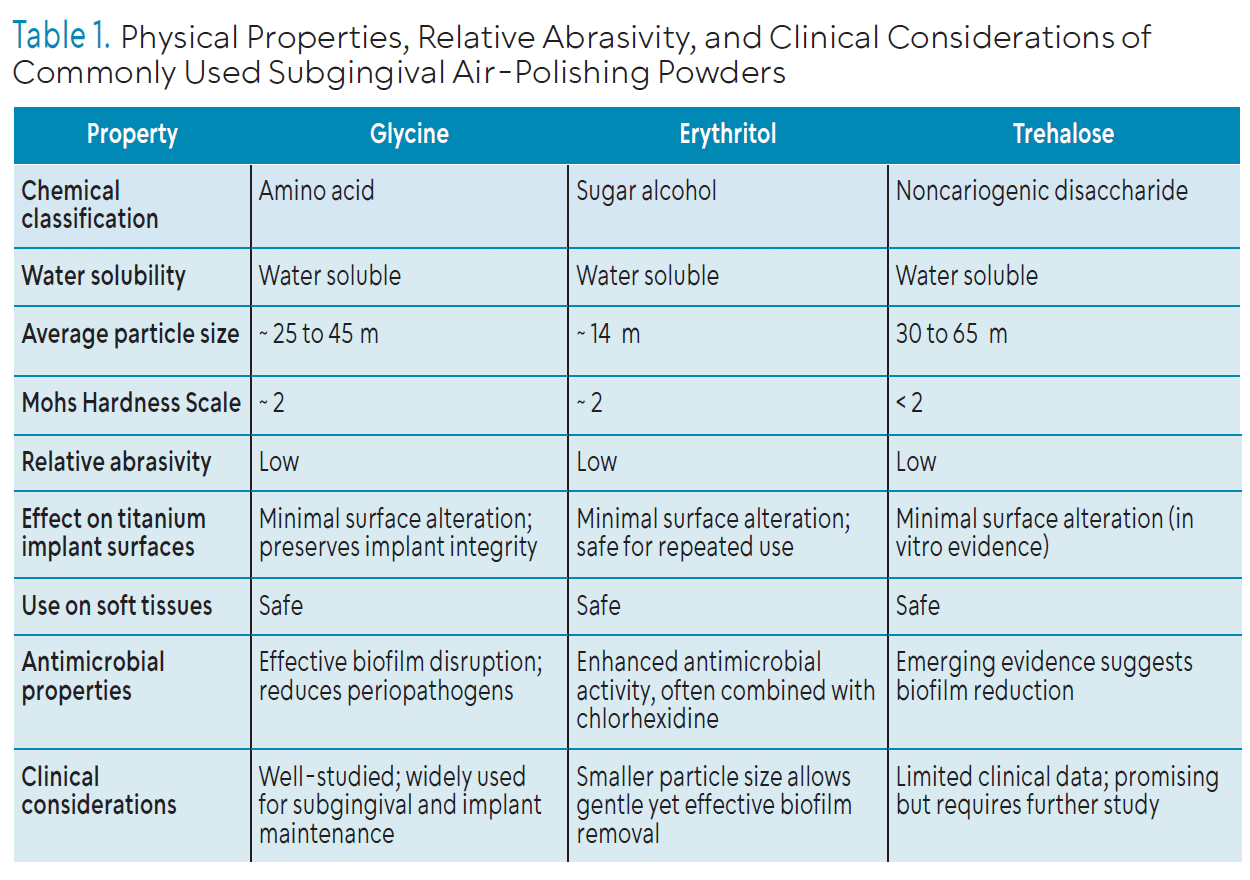
Powder characteristics, including particle size, hardness, and solubility, play a critical role in determining their suitability for use around natural teeth and implant surfaces. Table 1 summarizes key physical characteristics and clinical considerations associated with commonly used subgingival air-polishing powders, supporting their safe use on titanium implant surfaces when used according to manufacturer guidelines. Currently, glycine and erythritol powders are the most extensively studied and commonly used for subgingival air polishing. Both powders exhibit low abrasivity, small particle size, and have antimicrobial properties, making them appropriate for use in periodontal and peri-implant maintenance.15,22,23 Trehalose powder has more recently been introduced as an alternative low-abrasive option; however, its clinical application remains less established, with existing evidence primarily derived from in vitro and limited clinical studies.22-25
![]() Clinical Implications
Clinical Implications
Effective and ongoing maintenance of dental implants requires individualized clinical decision-making based on peri-implant tissue health, implant surface characteristics, and patient-specific risk factors such as history of periodontitis and oral hygiene practices.4,8 Mechanical instrumentation remains essential for removal of calculus deposits and for management of advanced peri-implant disease, particularly in sites with hard deposits or deep, inaccessible defects.8,10,16
Subgingival air polishing with low-abrasive powders such as glycine, erythritol, or trehalose is an effective adjunct for biofilm disruption during supportive implant maintenance.13,25 Subgingival air polishing has demonstrated clinical outcomes comparable to conventional debridement in residual periodontal pockets, while improving patient comfort and reducing treatment time.12,15,23-24 In 2015, a randomized clinical trial compared glycine air-polishing to conventional mechanical debridement for peri-implant mucositis; the study demonstrated significantly greater reductions in bleeding on probing and inflammation, along with improved patient comfort, and was also more effective at disrupting biofilm on implant surfaces without causing damage, making it a preferred approach for peri-implant maintenance.26
A 2025 review emphasized the reversible nature of peri-implant mucositis and represents a critical intervention point to prevent peri-implantitis. The article found that early detection, consistent maintenance, and the use of adjunctive therapies such as air polishing improve clinical outcomes, while patient-specific risk factors must be managed to ensure long-term peri-implant health.10
The use of low-abrasive air-polishing powders may enhance patient comfort and reduce the risk of implant surface alteration compared with more aggressive instrumentation techniques.21 Patients also frequently report lower pain perception and less gingival irritation with these powders than with hand or ultrasonic instruments.12,15 Selection of powder type should be guided by particle size, hardness, and available clinical and in vitro evidence, with particular consideration of biocompatibility and the limited long‑term data for newer powders.6,14,16,25
Experimental evidence demonstrates that glycine-, erythritol-, and trehalose-based powders effectively reduce subgingival biofilm and inflammatory parameters while maintaining acceptable cellular responses and preserving implant surface characteristics when used according to manufacturer guidelines.13,14,16,20,25 Accordingly, incorporating subgingival air polishing into comprehensive, evidence-based implant maintenance protocols may support peri-implant health while helping preserve implant and abutment surface integrity over time.4,11
Despite its clinical advantages, practical barriers may limit the routine adoption of subgingival air polishing. The initial investment in air-polishing units, along with the ongoing cost of low-abrasive powders can pose financial challenges. Clinicians must also account for the time required for device preparation, disassembly, cleaning, sterilization, and routine maintenance, including waterline flushing and powder chamber care, to ensure proper function and compliance with infection control standards. These steps may increase chairside turnover time compared with traditional instrumentation. In addition, successful implementation requires adequate training to ensure proper powder selection, angulation, and application time to optimize outcomes while minimizing tissue trauma and adverse effects. Although limited research specifically addresses barriers to implementation, careful consideration of these financial, logistical, and educational factors is essential when integrating subgingival air polishing into comprehensive implant maintenance protocols.
References
- Moraschini V, Da C Poubel L, Ferreira V, Barboza EDS. Evaluation of survival and success rates of dental implants reported in longitudinal studies with a follow-up period of at least 10 years: a systematic review. Int J Oral Maxillofac Surg. 2015;44:377–388.
- Cheung MC, Hopcraft MS, Darby BI. Dentists’ preferences in implant maintenance and hygiene instruction. Aust Dent J. 2021;66:278-288.
- Jayachandran S, Walmsley AD, Hill K. Challenges in dental implant provision and its management in general dental practice. J Dent. 2020:99:103414.
- Perussolo J, Donos N. Maintenance of peri-implant health in general dental practice. Br Dent J. 2024;236:781–789.
- Jepsen S, Berglundh T, Genco R, et al. Primary prevention of peri‐implantitis: Managing peri‐implant mucositis. J Clin Periodontol. 2015;42:S16.
- Tastepe CS, Lin X, Donnet M, Wismeijer D, Liu Y. Parameters that improve cleaning efficiency of subgingival air polishing on titanium implant surfaces: an in vitro study. J Periodontol. 2016;88:407–414.
- Toshniwal SH, Reche A, Bajaj P, Maloo LM. Status quo in mechanical plaque control then and now: a review. Cureus. 2022;14: e28613.
- Kwon T, Lamster IB, Levin L. Current concepts in the management of periodontitis. Int Dent J. 2020;71:462–476.
- Kurtzman GM, Horowitz RA, Johnson R, Prestiano RA, Klein BI. The systemic oral health connection: biofilms. Medicine (Baltimore). 2022;101:e30517.
- Pereira R, Sabri H, Nava P, Alrmali A, Wang HL. Treatment strategies for peri-implant mucositis: the final stop for preventing peri-implantitis. Int J Dent. 2025;2025:6901156.
- Araújo TG, Moreira CS, Neme RA, Luan H, Bertolini M. Long-term implant maintenance: a systematic review of home and professional care strategies in supportive implant therapy. Braz Dent J. 2024:35:e246178.
- Flemmig TF, Arushanov D, Daubert D, Rothen M, Mueller G, Leroux BG. Randomized controlled trial assessing efficacy and safety of glycine powder air polishing in moderate-to-deep periodontal pockets. J Periodontol. 2012;83:444-452.
- Wenzler JS, Krause F, Böcher S, et al. Antimicrobial impact of different air-polishing powders in a subgingival biofilm model. Antibiotics (Basel). 2021;10:1464.
- Weusmann J, Deschner J, Imber J, et al. Impact of glycine and erythritol/chlorhexidine air-polishing powders on human gingival fibroblasts: An in vitro study. Ann Anat. 2022;243:151949.
- Zhu M, Zhao M, Hu B, Wang Y, Li Y, Song J. Efficacy of glycine powder air-polishing in supportive periodontal therapy: a systematic review and meta-analysis. J Periodontal Implant Sci. 2021;51:147-162.
- Gheorghe DN, Bennardo F, Silaghi M, et al. Subgingival use of air-polishing powders: status of knowledge: a systematic review. J Clin Med. 2023;12:6936.
- Cosgarea R, Roccuzzo A, Jepsen K, Sculean A, Jepsen S, Salvi GE. Efficacy of mechanical/physical approaches for implant surface decontamination in non-surgical submarginal instrumentation of peri-implantitis. A systematic review. J Clin Periodontol. 2023;50(Suppl. 26):188–211.
- Liu CC, Dixit N, Hatz CR, et al. Air powder waterjet technology using erythritol or glycine powders in periodontal or peri-implant prophylaxis and therapy: A consensus report of an expert meeting. Clin Exp Dent Res. 2024;10:e855.
- Tan SL, Grewal GK, Mohamed Nazari NS, Mohd-Dom TN, Baharuddin NA. Efficacy of air polishing in comparison with hand instruments and/or power-driven instruments in supportive periodontal therapy and implant maintenance: a systematic review and meta-analysis. BMC Oral Health. 2022;22:85.
- Amate-Fernández P, Figueiredo R, Blanc V, Àlvarez G, León R, Valmaseda-Castellón E. Erythritol-enriched powder and oral biofilm regrowth on dental implants: an in vitro study. Med Oral Patol Oral Cir Bucal. 2021;26:e602-e610.
- Lupi SM, Granati M, Butera A, Collesano V, Rodriguez Y, Baena R. Air-abrasive debridement with glycine powder versus manual debridement and chlorhexidine administration for the maintenance of peri-implant health status: a six-month randomized clinical trial. Int J Dent Hyg. 2017;15:287–294.
- Janaphan K, Hill RG, Gillam D. Air-polishing in subgingival root debridement during supportive periodontal care: a review. J Orthod Craniofac Res. 2020;2:113.
- Kruse AB, Maamar R, Akakpo DL, et al. Effects of subgingival air-polishing with trehalose powder on oral biofilm during periodontal maintenance therapy: a randomized-controlled pilot study. BMC Oral Health. 2020;20:123.
- Jentsch HFR, Flechsig C, Kette B, Eick S. Adjunctive air-polishing with erythritol in nonsurgical periodontal therapy: a randomized clinical trial. BMC Oral Health. 2020;20:364.
- Weusmann J, Deschner J, Imber JC, Damanaki A, Leguizamón NDP, Nogueira AVB. Cellular effects of glycine and trehalose air-polishing powders on human gingival fibroblasts in vitro. Clin Oral Investig. 2022;26:1569-1578.
- Sahm N, Becker J, Santel T, Schwarz F. Non-surgical treatment of peri-implantitis using an air-abrasive device or mechanical debridement and local application of chlorhexidine: a prospective, randomized, controlled clinical study. J Clin Periodontol. 2011;38:872-878.
From Dimensions of Dental Hygiene. September/October 2026; 24(5):20-22,24