


Identifying Food Allergies in the Dental Chair
Recognizing the signs of oral allergy syndrome can help identify potential food triggers and guide appropriate follow-up.
This course was published in the November/December 2026 issue and expires December 2029. The author has no commercial conflicts of interest to disclose. This 2 credit hour self-study activity is electronically mediated.
AGD Subject Code: 730
EDUCATIONAL OBJECTIVES
After reading this course, the participant should be able to:
- Discuss the pathophysiology of oral allergy syndrome (OAS).
- Identify the clinical presentation of OAS.
- List patient management strategies for OAS.
Oral allergy syndrome (OAS), also known as pollen food allergy syndrome, is an immediate allergic reaction of the oral mucosa caused by food antigens.1 While patients with OAS may rarely present with symptoms in the dental setting, oral health professionals are well positioned to educate patients about this disorder and refer them to other healthcare providers for further evaluation. Because OAS symptoms primarily affect the oral cavity, recognizing the syndrome is particularly relevant to dental practice. Additionally, some oral care products contain ingredients that may cross-react with the same allergens implicated in OAS, underscoring the importance of oral health professionals’ understanding of this condition.
OAS was discovered in 1942 when Tuft and Blumstein2 noticed that individuals with pollen allergies often experienced sensitivity to fresh fruits. OAS typically occurs within minutes of consuming fresh fruits and vegetables and may cause itching of the palate and/or gingiva, erythema, numbness, swelling of the mouth, and tingling of the throat.1-4 Although pollen allergy does not always precede OAS, the condition is associated with immunoglobulin E (IgE) sensitivity to pollen and cross-reactivity between those allergens and proteins found in fruits and vegetables.5
While OAS is most common among children, it can also present in adults, most frequently among those with latex allergies.6 The prevalence of OAS ranges between 4.7% and 20% in children and 13% and 58% in adults.7
The onset of OAS is often sudden in teens and adults. It occurs when the immune system confuses proteins in raw fruit and vegetables with airborne pollen.8 Those with significant exposure to pollen may be at greater risk of developing OAS.8 Among adolescents and adults, approximately 30% to 60% of food allergies are related to pollen allergies.9 OAS has been extensively researched in the medical literature, particularly in the fields of allergy, immunology, and dermatology, but is infrequently covered in dental literature, despite its critical oral manifestations.
Pathophysiology
Some individuals have a genetic predisposition to develop allergies. However, OAS is related to sensitivity surrounding certain pollen allergens and subsequently to proteins contained in some foods; therefore, a genetic predisposition to OAS itself has not been established.10,11
OAS is diagnosed if a parent or caregiver answers affirmatively to the question: “Has your child ever had an itchy mouth or redness around his/her mouth after eating specific fruits and vegetables, especially when consumed raw?”5 The same question can be asked of adults.
According to the United States Centers for Disease Control and Prevention, one in four children has seasonal allergies, eczema, or food allergies.12 To confirm an OAS diagnosis, the patient must demonstrate both allergic symptoms and a positive skin prick test (SPT) conducted by a physician. Confirmation of OAS is a positive in vitro SPT with antigen-specific IgE results.
OAS is an IgE-mediated immediate hypersensitivity reaction that occurs after sensitization to a specific pollen allergen. When an individual consumes a food containing proteins that are structurally similar to pollen allergens, the IgE antibodies can recognize the food proteins and trigger the release of inflammatory mediators, resulting in localized symptoms. Common symptoms include itching or tingling of the lips, tongue, palate, and throat, as well as swelling of the oral tissues.13
Birch pollen is one of the allergens most commonly associated with OAS and may cross-react with proteins found in foods such as apples, cherries, peaches, carrots, and hazelnuts.14 Grass and ragweed pollen allergies may also cross-react with foods including watermelon, bananas, kiwifruit, carrots, peaches, and apples, potentially resulting in OAS.15
Clinical Presentation
The clinical presentation of OAS is varied; however, most individuals respond within 5 minutes of exposure to allergens. Symptoms include intra- and extraoral erythema, irritation of lining of the oral mucosa, angioedema, vascular edema, narrow throat, itching, pain, and, less frequently, blister formation (Figures 1 and 2).16 OAS can also affect the tissues that are in direct contact to the allergens, including the oropharynx and the gastrointestinal tract.
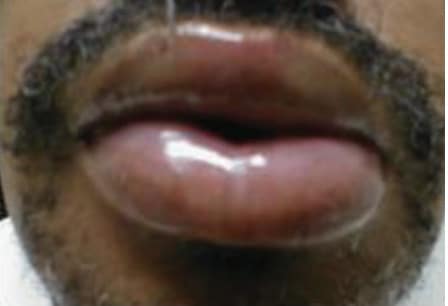
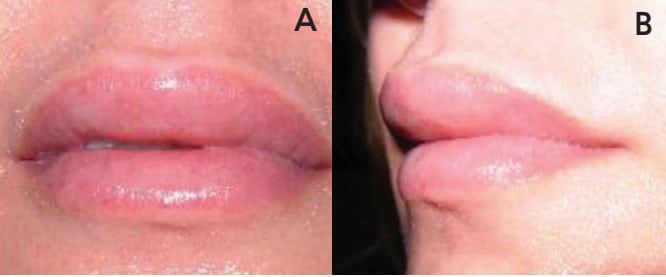
Clinical symptoms of OAS are only caused by fresh food — not boiled, baked, canned, chemically treated, or frozen foods. Although the symptoms of OAS can occur at any time, they are most common during the pollination season.3 Essentially, patients are unable to tell the difference between proteins in specific fruit and vegetables, proteins in tree pollens, and potential allergens in the dental office (Tables 1 and 2).
| Pediatric Allergens | Adult Allergens |
|---|---|
| Apple | Carrot |
| Peach | Celery |
| Cherry | Hazelnut |
| Pear | Melon |
| Carrot |
| Angioedema |
| Anaphylaxis |
| Urticaria |
| Breathing difficulties |
| Contact stomatitis |
Dental Hygiene Process of Care
OAS should be included in the medical history, along with latex allergies (Table 3). During the intra- and extraoral examination, any oral findings that support a diagnosis of OAS should be discussed with the patient or the patient’s parent/caregiver. In some cases, patients who are allergic to rosin, for example in fluoride varnish, may present with OAS.17-19
| Low | Moderate | High |
|---|---|---|
| Hazelnut | Apple | Avocado |
| Strawberries | Celery | Kiwi |
| Mango | Carrots | Banana |
| Peanut | Tomato | Chestnut |
According to a 2023 study published in Scientific Reports, food allergens were frequently identified in oral care products, with the highest prevalence found in fluoride varnishes, toothpaste, and alginates.19 Fruits and spices were the most frequently identified allergens, and fruit-derived ingredients were found in several oral care products, including toothpaste and fluoride varnish. Because certain fruit proteins can cross-react with pollen allergens, these ingredients may be relevant to patients with OAS.19
Changes in oral findings can be assessed through bimanual palpation, careful examination of the oral mucosa, and a detailed history of patients’ symptoms, including their onset and progression over time.20 Patients’ medical history should include any allergic stimuli and responses. Patients or parents/caregivers may be asked about prior allergic responses, especially to pollen and nuts. Patients who disclose allergies should receive an appropriate referral to a general practitioner or an allergist.21
Documentation
OAS cases must be documented correctly, and appropriate referrals made. Findings should be part of the medical history documentation as a subjective, objective, assessment, and plan (SOAP) note in the patient’s progress notes/clinical notes (Table 4). The IgE assay is the most specific among the laboratory tests to confirm OAS.22 Patients should be encouraged to keep a food journal to see if their symptoms correlate with any of the triggering foods.
| Objective | Subjective |
|---|---|
| Location | How long has it been present? |
| Size | Is it painful? |
| Color | Where did you first notice it appear? |
| Texture | Has this happened before? |
Differential Diagnosis
A differential diagnosis is necessary with OAS as early symptoms are common among all types of allergic reactions including angioedema, paresthesia, and burning sensations.23 A physician or allergist should confirm an OAS diagnosis. True allergic reactions are uncommon in the oral cavity; however, angioedema, generalized erythema, and peri-oral dermatitis are sometimes present without OAS.
Patient Management
Patient education is central to an effective long-term approach for treating OAS. Patients or caretakers should learn how to read food labels and assess how to avoid allergens. Most patients with OAS can be treated with food avoidance and medication, including epinephrine autoinjectors and antihistamines, both of which can block immune pathways.
Patients with a history of anaphylaxis should keep an epinephrine autoinjector with them at all times (Table 5). In the event of an allergic reaction, patients should stay calm and rinse their mouth with plain water. Hot but not boiling beverages can help inactive residual allergens in the mouth and may make the patient more comfortable before the antihistamine becomes effective.22 Some patients can mitigate their OAS rection with immunotherapy for pollen.21
| Step 1. Administer epinephrine autoinjector every 5 to 15 minutes as needed. |
| Step 2. Call 911 and remain with the patient until emergency services arrive. |
Cooking or peeling triggering foods can help prevent or reduce a reaction for most patients with OAS.8 Cooking may minimize sensitivity to fruit and vegetables in specific instances; however, not in acute situations. Acute situations, such as anaphylaxis, need to be treated immediately with an epinephrine autoinjector.
Patients experiencing a reaction in the dental office should not be left alone. Emergency services should be called and medical support provided. Following any emergency, patients should be monitored and adjustments made to their dental treatment plan in order to prevent future allergic reactions.
Patients who have experienced systemic symptoms or anaphylaxis due to OAS should follow up with their primary care physician or allergist. In general, patients should follow a strictly monitored diet and carry an adrenaline auto-injector, antihistamines, or oral glucocorticoid, and/or wear a medical bracelet. Depending on the severity of a patient’s reaction, he or she may need firstline, lifesaving treatment.
Diphenhydramine can be used in the dental office, however, most offices do not typically weigh their patients and injectable diphenhydramine is measured by milligram per kilogram body weight. As such, an epinephrine autopen is a much more simple approach. With an injectable/oral diphenhydramine, the patient may be treated as if he or she were presenting minor symptoms and not anaphylaxis.3 The primary care for patients with OAS is avoiding foods and allergens that initiate the allergic response.24
If a patient is having difficulty breathing or he or she has swelling that may reduce the size of the esophagus, he or she should be injected with epinephrine. The recommended dose is an autoinjector-administered intermuscular dose every 5 to 15 minutes as needed. If an epinephrine autoinjector is required, 911 must be contacted.14
The risk of OAS developing in the dental office is low, however, the same procedures required for a medical emergency should be used as needed. Note, patients with prior known allergic reactions and asthma are more likely to develop OAS as both children and adults.
Interprofessional Collaboration
Interprofessional collaboration provides an opportunity to discuss the patient’s medical condition, provide appropriate care, and disclose any known triggers to OAS. Interprofessional collaboration will help ensure treatment is provided safely. It creates an opportunity for the oral health professional to speak with the allergist, primary care physician, and dietitian to support nutritional counseling and avoid foods or dental materials that can trigger OAS.
All dental offices must have clear written emergency management protocols. Such a protocol must include the entire oral healthcare team and an annual training on the importance of the dental team’s role in an emergency should be provided. One dental team member should be responsible for reviewing the contents of the emergency kit and ensuring all medications are up to date.
Conclusion
While OAS is not well represented in the dental literature, oral health professionals need to understand how to detect and treat OAS and provide appropriate referrals. OAS should be reviewed in the patient’s health history, and the potential for an oral allergic reaction should be identified. Appropriate preparedness can help prevent an allergic reaction and enable clinicians to note signs and provide treatment.
Acknowledgment
The author would like to thank Gwen Cohen-Brown, DDS, FAAOMP, FACD, for providing the images and her assistance with this manuscript.
References
- Amlot PL, Kemeny DM, Zachary C, Parkes P, Lessof MH. Oral allergy syndrome (OAS): symptoms of IgE-mediated hypersensitivity to foods. Clin Exp Allergy. 1987;17: 33-42.
- Tuft L, Blumstein GI. Studies in food allergy: II. Sensitization to fresh fruits: clinical and experimental observations. J Allergy. 1942;13:574-582.
- Ivković-Jureković I. Oral allergy syndrome in children. Int Dent J. 2015;65:164-168.
- Bedolla-Barajas M, del Campo MCIM, Morales-Romero J, et al. Prevalence and associated factors of oral allergy syndrome among Mexican adults: a survey-based study. Indian J Otolaryngol Head Neck Surg. 2025;77:1768-1774.
- Kiguchi T, Yamamoto-Hanada K, Saito-Abe M, et al. Pollen-food allergy syndrome and component sensitization in adolescents: a Japanese population-based study. PLoS One. 2021;16:e0249649.
- Metcalfe DD, Sampson HA, Simon RA, Lack G, eds. Food Allergy: Adverse Reactions to Foods and Food Additives. 5th ed. Boston: Wiley-Blackwell; 2014.
- Carlson G, Coop C. Pollen food allergy syndrome (PFAS): a review of current available literature. Ann Allergy Asthma Immunol. 2019;123:359-365.
- Cleveland Clinic. Oral Allergy Syndrome (OAS). Available at https://my.clevelandclinic.org/health/diseases/23996-oral-allergy-syndrome. Accessed October 1, 2026.
- Özdemir E, Damadoğlu E, Karakaya G, Kalyoncu AF. Prevalence and clinical features of pollen-food allergy syndrome in adults with seasonal allergic rhinitis. Eur Rev Med Pharmacol Sci. 2023;27:103-109.
- Valenta R, Hochwallner H, Linhart B, Pahr S. Food allergies: the basics. Gastroenterology. 2015;148:1120-1131.
- American Academy of Allergy, Asthma & Immunology. Atopy. Available at aaaai.org/tools-for-the-public/allergy,-asthma-immunology-glossary/atopy-defined. Accessed October 1, 2026.
- Sorokman T, Sokolnyk S, Cherney N, Gingulyak M, Ostapchuk V. Risk factors for the formation of oral allergy syndrome in children. Ro J Pediatr. 2025;74:83-90.
- Dayananarayana U, Shastry SP, Shankar C, et al. Allergic manifestations in the oral cavity. J Calif Dent Assoc. 2022;50:245-255.
- Kallen EJJ, Welsing PMJ, Löwik JM, et al. The effect of subcutaneous and sublingual birch pollen immunotherapy on birch pollen–related food allergy: a systematic review. Front Allergy. 2024;5:1360073.
- Marzec A, Mysiorska D, Mtynska J, et al. Pollen-food allergy syndrome in children: global prevalence and pathogenesis. Nutrients. 2026;18:2246.
- Mujayanto R, Almas M, Wisaputri DV. Oral allergy syndrome: Two case reports in dental practices. J Indones Oral Med Soc. 2023;1:14-18.
- American Academy of Allergy, Asthma & Immunology. Ask the Expert: Fluoride. Available at aaaai.org/allergist-resources/ask-the-expert/answers/2024/fluoride. Accessed October 1, 2026.
- Baik A, Alamoudi N, El-Housseiny A, Altuwirqi A. Fluoride varnishes for preventing occlusal dental caries: a review. Dent J (Basel). 2021; 9:64.
- Coimbra L, Costa IM, Evangelista JG, Figueiredo A. Food allergens in oral care products. Sci Rep. 2023;13:6684.
- Oral Cancer Foundation. Cancer Screening Protocols. Available at oralcancerfoundation.org/discovery-diagnosis/cancer-screening-protocols. Accessed October 1, 2026.
- Finley A, Atkinson E. Subcutaneous immunotherapy for pollen food allergy syndrome: a systematic review. J Allergy Clin Immunol. 2021;147(2 Suppl):AB107.
- Kashyap RR, Kashyap RS. Oral allergy syndrome: an update for stomatologists. J Allergy (Cairo). 2015;2015:543928.
- Nucera E, Aruanno A, Rizzi A, Centrone M. Latex allergy: current status and future perspectives. J Asthma Allergy. 2020;13:385-398.
- Lugović-Mihić L, Ilić I, Budimir J, Pondeljak N, Mravak Stipetić M. Common allergies and allergens in oral and perioral diseases. Acta Clin Croat. 2020;5:318-328.
From Dimensions of Dental Hygiene. November/December 2026; 24(6):40,43-45