

The Surprising Power of Language in Driving Patient Compliance
New findings suggest that clearer, more direct language about periodontal diseases may significantly improve patient motivation and adherence.
As a periodontist, I wanted to explore whether the specific words I use when discussing periodontal diseases with my patients influence their motivation to improve their oral health. So, I decided to conduct a pilot study of 100 patients in my practice who rated various words and phrases on a scale of 1 to 5 based on how motivating they found them.1
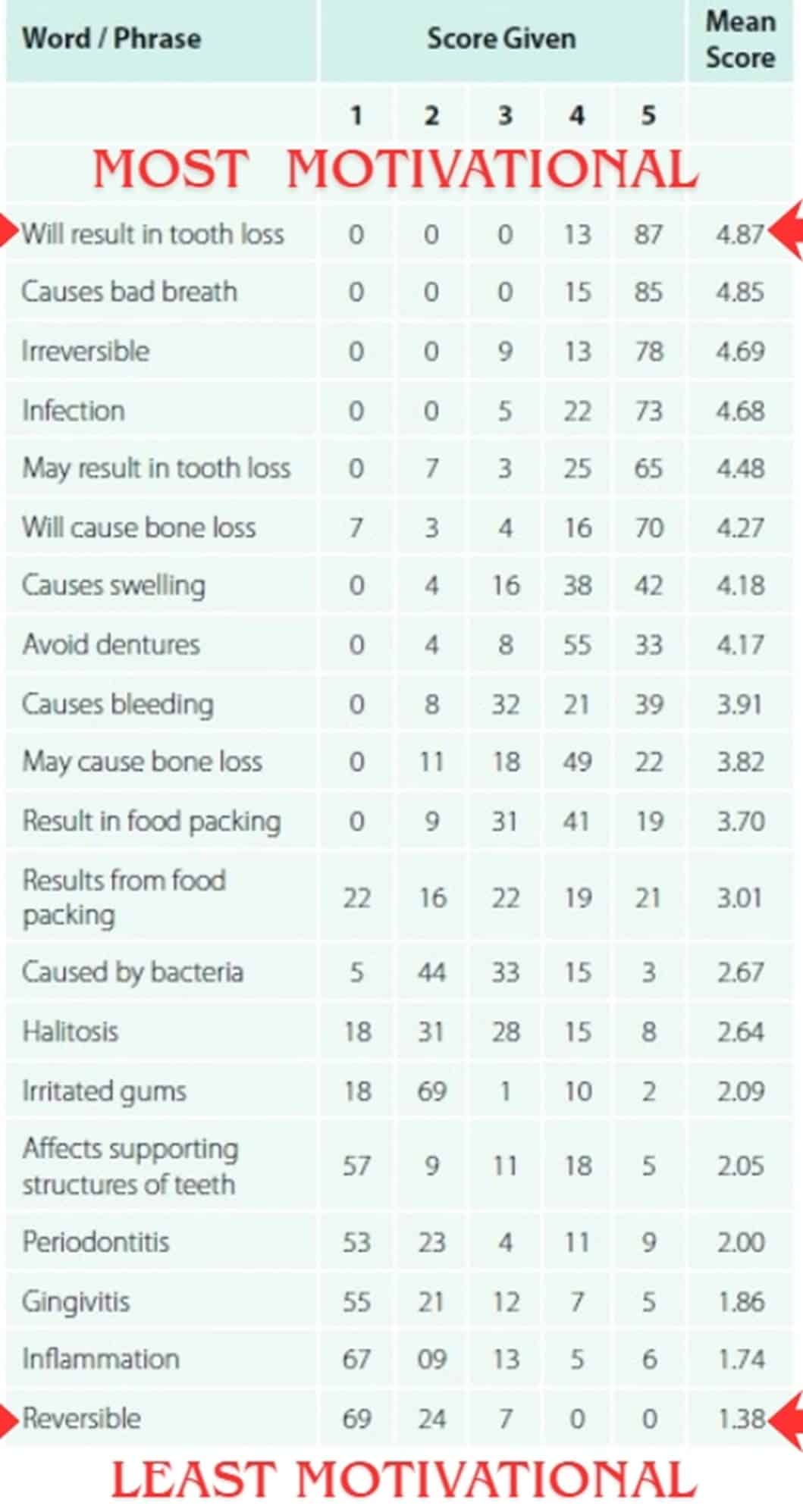
The findings were unexpected, yet clinically intuitive (Figure 1). Participants had been referred over a 6-month period for ongoing or recurrent periodontal diseases, and all had previously received treatment. Many presented with recession and esthetic concerns, such as dark interdental spaces. During consultations, patients frequently expressed regret, often stating they wished the condition had been explained more clearly or more firmly earlier in their care.
While this regret is understandable, it does not necessarily reflect poor care. Patient compliance with self-care remains a well-documented challenge, and outcomes are highly dependent on it.2-8 Additionally, patients often report receiving inconsistent messaging from different healthcare providers, which can further reduce adherence.9
A key trend emerged: terminology perceived as more severe was rated as more motivating. This aligns with behavioral science suggesting that clearly communicated risk can drive behavior change, although some bias from patient regret may exist.10
This small study offers practical value by identifying language patients themselves find motivating. While the use of targeted communication has long been recommended, limited data exist on which specific terms are most effective.11-13 I hope that, in the future, more robust research will be conducted on this important topic.
In my own practice, I now use clear, concise statements such as:
- Gum disease is an infection that permanently destroys the bone supporting your teeth.
- As bone is lost, teeth may become loose.
- Without enough support, teeth can shift or be lost.
Although direct, this language reflects the true severity of the disease. When delivered with empathy and professionalism, it improves patient understanding and, in my experience, increases engagement with care. Once patients appreciate the seriousness of their condition, positive tones can be introduced by discussing the benefits of resolving the disease. I’ve found that after communicating directly and clearly with my patients about the seriousness of their oral health status, they almost always express gratitude for the unambiguous nature of my communication. The message contains bad news, but I deliver it gently with a measured, polite firmness.
References
- Ahmed H. The behavioural influence on a patient of a clinician’s choice of topic specific words. Dental Health. 2024;3:34-37.
- Chapple ILC, Hill K. Getting the message across to periodontitis patients: The role of personalised biofeedback. Int Dent J.2008;58:294–306.
- Abbinante A, Antonacci A, Antonioni M, et al. Concordance and clinical outcomes improvement following oral hygiene motivation: A systematic review and report of the workshop of the Italian Societies of Dental Hygiene. Int J Dent. 2024;2024:8592336.
- Doceda MV, Petit, Huck O. Behavioural interventions on periodontitis patients to improve oral hygiene: A systematic review. J Clin Med.2023;12(6):2276.
- Haynes RB. Introduction. In: Compliance in Health Care. Baltimore: John Hopkins University Press. 1979.
- Buckalew LW, Sallis RE. Patient compliance and medication perception. J Clin Psychol. 1986:42:49-53.
- Morris LS, Schulz RM. Patient compliance- an overview. J Clin Pharm Ther. 1992:17:283-295.
- Brown JC. Patient non-compliance — a neglected topic in dentistry. J Am Dent Assoc. 1981;103:567-569.
- Bissett SM, Stone KM, Rapely T, Preshaw PM. An exploratory qualitative interview study about collaboration between medicine and dentistry in relation to diabetes management. BMJ Open. 2013;3:e002192.
- DeMatteo MR, DiNicola DD. Achieving Patient Compliance. New York: Pergamon Press Inc; 1982.
- Suchman AL, Markakis K, Beckman HB, Frankel R. A model of empathetic communication in the medical interview. JAMA. 1997:277:678-682.
- General Dental Council. Standards for the Dental Team. Available at https://www.gdc-uk.org/standards-guidance/standards-and-guidance/standards-for-the-dental-team. Accessed March 27, 2026.
- Asimakopoulou K. A good relationship and good communication are not sufficient for patient-centred care. Brit Dent J. 2015;219:105-106.