
It’s All About the Governance
We sometimes experience moments in our careers that are not only “Aha” but “Oh wow!” They can come from interactions with colleagues, learning about new techniques, and knowledge-sharing with our peers. Often, these situations can create a breakthrough moment.
We sometimes experience moments in our careers that are not only “Aha” but “Oh wow!” They can come from interactions with colleagues, learning about new techniques, and knowledge-sharing with our peers. Often, these situations can create a breakthrough moment.
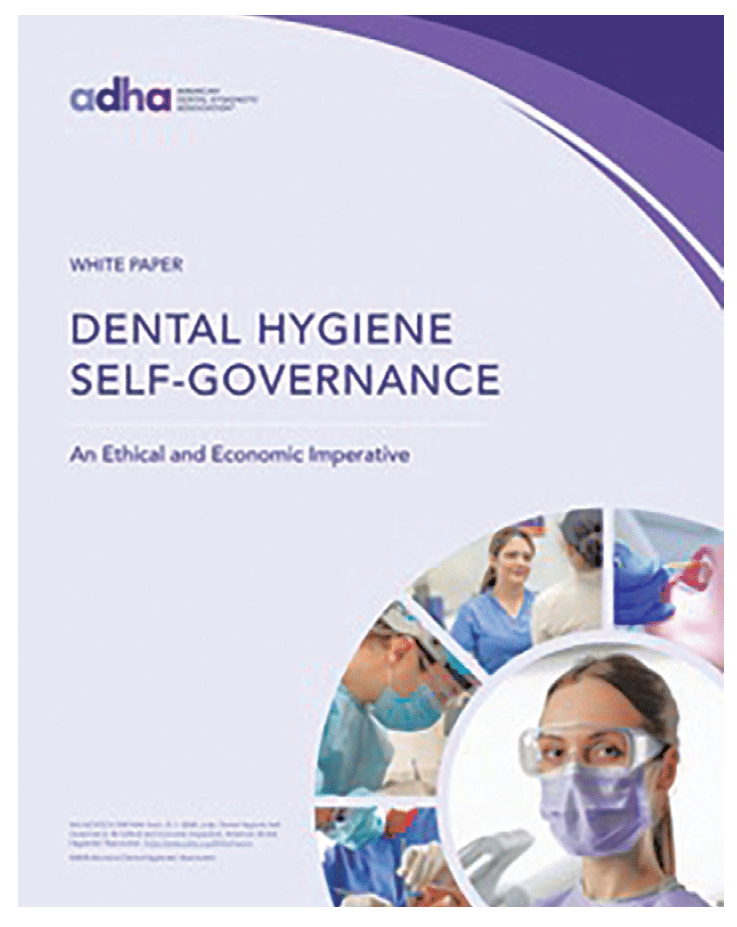 I initially was going to write on a different topic in this Editor’s Note until I opened an email message that completely changed my direction. A just-released white paper from the American Dental Hygienists’ Association titled, “Dental Hygiene Self-Governance: An Ethical and Economic Imperative” appeared in my inbox.1 My initial thought was that the paper was likely a rehashing of the self-regulation concept that we’ve focused on for so long. Yes, that’s an important topic, but then I noticed the word “self-governance” in the title. I was intrigued … what’s the difference? I read the paper and immediately knew it was a game changer.
Why self-governance instead of self-regulation? There are important differences between the two concepts, and both are necessary to have a viable, relevant, legitimate profession. Simply put, self-regulation connotes oversight while self-governance grants authority. Self-regulation is important for overseeing the conduct within the profession, self-governance defines the profession itself. You can see how using the appropriate term is significant when we consider what we want to accomplish. As stated in the paper, “Each profession must be supported by structures that reflect its distinct roles, responsibilities, and competencies.” If we want to achieve a profession that better aligns our authority, education, and public need, then self-governance is the goal. And as described in the paper, this is the overall premise of the Dental Hygiene Modernization Act. This act provides a framework for how to attain self-governance.
The white paper comes at a crucial time, with the many challenges facing our profession, including dilution of our education and skills. The author of the paper, Derik J. Sven, DHSc, MBA, MPH, RDH, CDT, FADHA, FAADH, notes, “The Dental Hygiene Modernization Act is not about independence for its own sake, nor is it about disrupting the current workforce. It provides states with a framework to expand authority through a clearly defined pathway based on education, experience, and demonstrated competence while preserving collaboration and respecting the many ways dental hygienists practice today.”
In August, the Dimensions’ Discovery EXPO included a legislative forum, along with a panel focused on the registered dental hygienist advanced practice designation. One word that resonated throughout both discussions was autonomy. If we had the autonomy to work in nontraditional settings, we could have a greater impact. If we had the autonomy to regulate ourselves, we could ensure a more cohesive standard of practice across the country. If we had the autonomy of separate dental and dental hygiene governing boards, we wouldn’t face many of the ethical dilemmas imposed on us now.
It’s time to stop saying “if” and start saying “when.” Self-governance is the way.
Jill Rethman, RDH, BA, FADHA
Editor in Chief
jrethman@belmontbusinessmedia.com
Reference
- Sven DJ. Dental hygiene self-governance: an ethical and economic imperative. Available at adha.org/advocacy/adha-white-papers/. Accessed August 22, 2026.
From Dimensions of Dental Hygiene. September/October 2026; 24(5):6