
A Brighter Smile Starts With Baking Soda
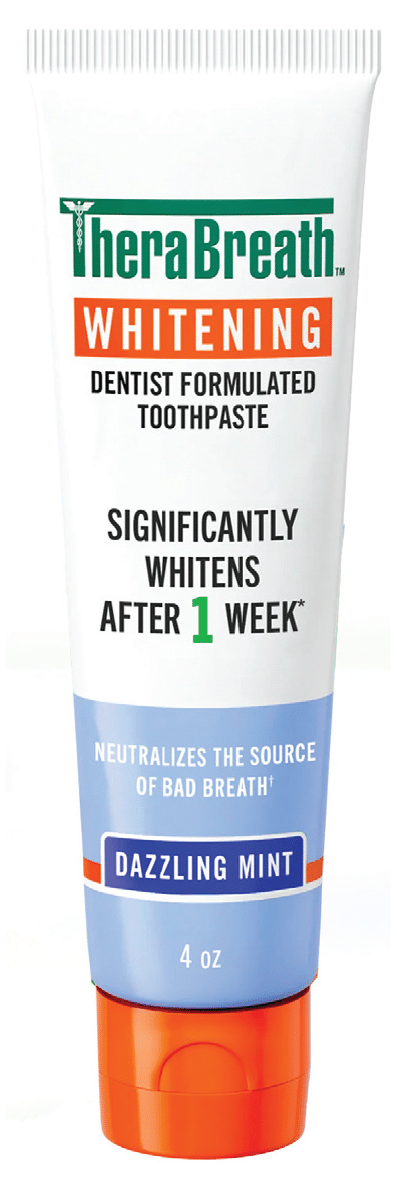
TheraBreath NaF Whitening Toothpaste delivers significant reductions in extrinsic tooth stain.
 Extrinsic tooth stain remains one of the top esthetic concerns reported by patients, often driven by routine dietary exposures as well as lifestyle factors. These surface stains are often not indicative of underlying disease but can significantly affect a patient’s perception of oral health, appearance, and overall confidence. Although professional whitening procedures continue to advance, many patients (and oral health professionals) prefer to start with an effective whitening toothpaste that provides visible results without added inconvenience, cost, or sensitivity.
A recently presented clinical study offers strong evidence supporting the use of a baking soda–based whitening dentifrice as an effective option for managing extrinsic stain.1 The findings suggest that this formulation represents a meaningful option in over-the-counter whitening for managing extrinsic stain by combining measurable efficacy with safety and ease of integration into daily routines.
Extrinsic stains form on the enamel surface through repeated contact with chromogenic agents and become incorporated into the acquired pellicle. Because these stains reside on the outermost layer of the tooth, their removal depends largely on mechanical and chemical disruption. As a result, dentifrice formulation plays a critical role in determining how effectively daily brushing can address discoloration.
A Rigorous Clinical Evaluation
An Investigational Review Board–approved, randomized, double-blind, parallel-group clinical trial evaluated a baking soda–containing fluoride toothpaste compared to a standard sodium fluoride control 6 weeks.1 Participants included healthy adults ages 18 to 65 with measurable levels of extrinsic stain. Subjects brushed twice daily for 2 minutes using their assigned toothpaste and were evaluated at baseline and on days 7, 14, 28, and 42. Stain accumulation was measured using the Modified Lobene Stain Index, which assesses both stain intensity and surface area to generate a total stain score.
The study demonstrated statistically significant reductions in extrinsic stain for the baking soda toothpaste at all evaluated time points. Compared with the control dentifrice, total stain reduction reached 35% at day 7; 48% at day 14; 56% at day 28; and 65% at day 42. Improvements were observed across both stain area and intensity, with highly statistically significant differences between groups (p < 0.0001).
Mechanism of Action
The effectiveness of baking soda–based dentifrices is attributed to a dual mechanism. Sodium bicarbonate serves as a mild abrasive to remove pellicle-bound stains while its buffering properties enhance debris removal and help neutralize acids. When combined with fluoride, the formulation supports both esthetic and anticaries benefits.
No adverse events were reported, supporting the suitability of baking soda toothpaste for daily use and reinforcing its role as a well-tolerated whitening option.
Clinical Implications
These findings support recommending baking soda–based dentifrices as part of a comprehensive approach to stain management. They can help maintain whitening results between professional cleanings while promoting consistent oral hygiene habits.
This clinical investigation demonstrates that TheraBreath Whitening Toothpaste, formulated with baking soda, can deliver a meaningful reduction in extrinsic stain within just 1 week of regular use, with progressive improvements up to 6 weeks with continued use. With strong efficacy data, excellent safety outcomes, and ease of integration into daily routines, this product represents a practical solution for patients seeking gentle yet effective stain removal and whitening.
TheraBreath
800-447-6666
Reference
- Vazquez J, Mateo LR, Peters G, et al. Baking soda toothpaste reduces extrinsic stain to whiten teeth. Presented at: International Association for Dental, Oral, and Craniofacial Research General Session and Exhibition; March 25–28, 2026; San Diego.
From Dimensions of Dental Hygiene. September/October 2026; 24(5):27