


Community Health Workers Are Making a Difference in Improving Oral Healthcare Access
Trusted community advocates are helping break down barriers to dental care, improve health literacy, and connect underserved populations with the oral health services they need most.
This course was published in the July/August 2026 issue and expires August 2029. The author has no commercial conflicts of interest to disclose. This 2 credit hour self-study activity is electronically mediated.
AGD Subject Code: 149
EDUCATIONAL OBJECTIVES
After reading this course, the participant should be able to:
- Describe the role of community health worker (CHWs) in promoting oral health and reducing disparities.
- Identify strategies and behavior change models used by CHWs to improve outcomes.
- Discuss challenges and future opportunities for integrating CHWs into oral healthcare.
Ongoing disparities in oral health remain a significant public health concern.1 Community health workers (CHWs) play a key role in bridging the gap between healthcare systems and communities by using cultural insight and community collaboration.2
As healthcare systems recognize the value of community-based interventions, CHWs are significantly impacting oral health promotion. Through education, outreach, and care coordination, they address the underlying causes of health disparities and encourage lasting behavioral changes. However, their role is often limited by inconsistent training standards, ambiguous roles, and unstable funding.
Today, an estimated 58,550 CHWs practice in the United States , primarily in schools, community centers, and patient homes.3 A CHW is a frontline public health worker who connects people to health and social services; helps improve service delivery; and builds community capacity by providing outreach, education, support, and advocacy.4 CHWs serve as trusted liaisons between health systems and residents. CHWs do not need to come from healthcare backgrounds, but rather close ties with their communities make them especially effective. They provide culturally appropriate health education, support, care coordination, and advocacy.
While CHWs receive training through state-approved or community-based programs, collaboration with dental hygienists is essential in oral health settings. Dental hygienists contribute clinical expertise and evidence-based guidance, while CHWs help ensure that health messages are delivered in ways that align with the values, beliefs, and needs of the communities they serve.
CHWs receive training tailored to the populations they serve. They can pursue various pathways, including certificate programs offered by the Michigan Department of Health and Human Services (MDHHS) and Michigan Community Health Worker Alliance.5 Training opportunities are also available through the National Association of Community Health Workers (NACHW).6 Some CHWs receive training through instructor-led programs or job shadowing.
The American Dental Association also introduced a type of CHW, the community dental health coordinator (CDHC). CDHCs are specially trained CHWs with an oral health focus who serve as a bridge between underserved populations and dental care providers. Working in schools, community centers, long-term care facilities, and other community settings, CDHCs help individuals navigate the healthcare system, connect with dental homes, overcome barriers, such as transportation and financial challenges, and receive oral health education tailored to their needs. The program emphasizes prevention, care coordination, and community outreach, making CDHCs uniquely positioned to address oral health disparities and improve access to care among vulnerable populations. By combining community engagement skills with oral health knowledge, CDHCs represent a valuable extension of the dental team.7
CHWs extend the reach of traditional healthcare providers by addressing barriers to care, supporting patients through education and advocacy, and linking clinical and community resources.1 Their efforts improve population health, reduce health disparities, and contribute to more efficient and effective healthcare delivery.
The Role of Community Health Workers in Oral Health
An increasingly popular strategy for preventing dental disease and improving community health is integrating oral health promotion into primary care. This approach not only supports the prevention of dental diseases but also encourages healthier lifestyles through consistent, community-based interventions.8
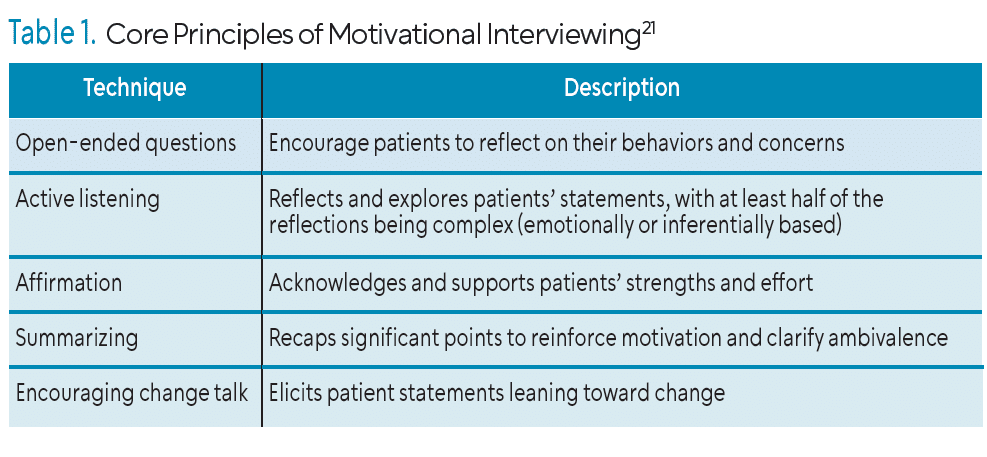
In US-based models, the role of the CHW centers on education, navigation, and connecting individuals to appropriate care.1 CHWs use behavior change models, such as the health belief model (HBM), to encourage healthy lifestyle changes. The HBM explains why people may not engage in preventive healthcare behaviors by assessing perceived susceptibility to dental disease, potential severity of untreated dental conditions, and benefits of preventive care.9 CHWs also use motivational interviewing to support behavior change (see Table 1).10,11
 CHWs increase access to dental care by navigating, referring, educating, and coordinating care.1 Many CHWs work with dental offices to refer individuals for treatment and help them establish ongoing care. They also support individuals in understanding insurance coverage, completing enrollment processes, and addressing financial or logistical barriers that may delay care. Through these efforts, CHWs enable individuals to better utilize available services. They also educate communities by sharing information and distributing oral hygiene products through printed materials and presentations.
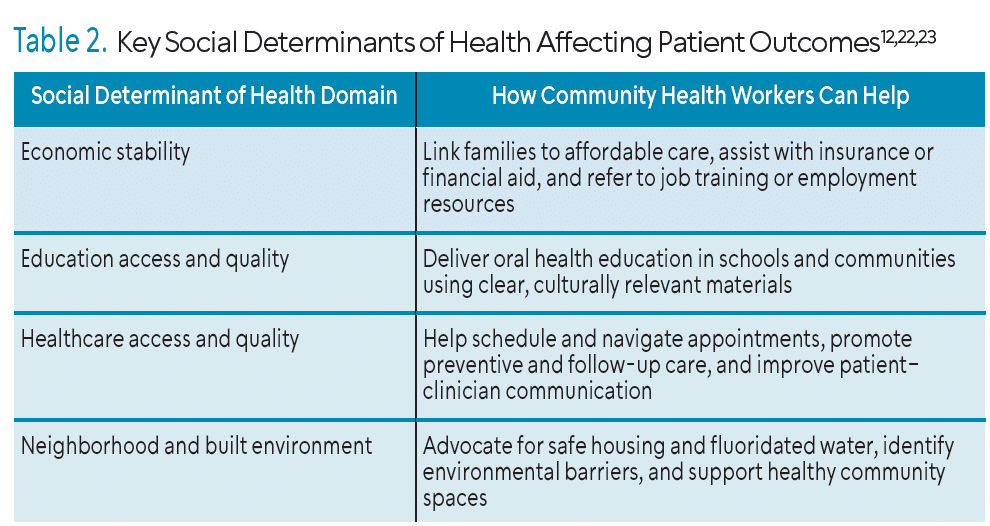
CHWs support their communities by raising awareness of social determinants of health (SDOH), the conditions in which people live, such as income, education, and environment, and by connecting individuals to local resources (Table 2).12-14 Enhancing organizational awareness of SDOH is vital for effectively supporting community health. Additionally, expanding care coordination is crucial to delivering seamless, integrated healthcare, as it enables communication among care teams.4
Equally important, CHWs play a significant role in increasing consumer satisfaction and building trust in healthcare organizations. When patients feel satisfied with their care and trust their providers, they are more likely to engage with health services and follow recommended treatments, ultimately, improving health outcomes. Furthermore, CHWs provide culturally competent care, which addresses the unique needs of diverse populations and helps reduce health disparities.15
CHWs aid in improving health outcomes for individuals with limited English proficiency by facilitating tailored communication, providing language assistance, and delivering culturally appropriate health education. They can also serve as knowledgeable guides, bridging gaps with interpreter services and enhancing patient engagement within healthcare organizations.12 When serving rural populations, CHWs are instrumental in addressing barriers such as limited access to healthcare providers, transportation challenges, and a lack of specialized services.
Individuals with chronic health conditions are well served by CHWs as they provide ongoing support, education, and resources. Monitoring individuals’ oral health progress, coordinating care between dental and medical clinicians, and promoting adherence to treatment plans are key ways CHWs help improve quality of life and long-term outcomes.
In addition, CHWs support the delivery of behavioral health care by integrating mental health and substance use education into oral health promotion, offering screenings, referrals, and educational resources.8 By facilitating comprehensive care coordination and communication, CHWs help ensure that individuals receive support for their oral health and overall health needs.
Promoting preventive oral health care, reducing unnecessary emergency visits, and preventing costly complications through patient education and outreach are all cost-management strategies provided by CHWs. These efforts help reduce operational expenses while maintaining, or even enhancing, the quality of oral healthcare provided to communities.4
Challenges and Considerations
Lack of standardized training and certification requirements, varying scopes of practice between states, and limited professional organizations all present challenges for CHWs. Additionally, there is a lack of clearly defined roles. Many organizations continue to add tasks to CHWs’ job descriptions, blurring distinctions between trained and certified CHWs.16 This can lead to inadequate compensation and limited career advancement. Many CHWs are underpaids, which can affect motivation and retention. At times, CHWs are not fully recognized as valuable team members by healthcare professionals.
Expanding beyond disease management to address SDOH, integrating CHWs into care teams, clarifying roles, and ensuring proper documentation and reimbursement structures are all common challenges. Success relies on organizational support, team collaboration, and ongoing evaluation.17 Unclear job descriptions for CHWs can lead to overlooked tasks, missed health interventions, role overlap, and working beyond their competence. This confusion can also hinder collaboration, as partners may not know how to engage or support CHWs.
Clarifying CHW roles through coordinated efforts by policymakers, healthcare organizations, employers, and professional associations is essential to maximizing their benefits.18 Efforts should focus on establishing standardized scopes of practice, defining core competencies, and developing sustainable reimbursement mechanisms to support effective integration into healthcare systems.
The lack of sustainable funding and reliance on unstable grant-based support continue to create barriers to long-term CHW workforce stability. Schmit et al19 note that many CHW funding mechanisms depend on state appropriations or short-term grant programs, which limit long-term reliability. Policy and regulatory constraints also restrict CHW roles, especially due to inconsistent terminology and variation in reimbursement eligibility across states. Enabling CHW reimbursement from Medicaid and other public assistance models would create a more sustainable option because they function as entitlement-based funding that can better support long-term CHW integration and service delivery.20
Although standardized CHW training is lacking, reputable websites provide useful resources. In Michigan, MDHHS and the Michigan Community Health Worker Alliance (MiCHWA) offer reliable information on training opportunities.4,21 MiCHWA training covers CHW roles in public health and health systems, legal and ethical responsibilities, community resource navigation, communication and cultural responsiveness, teaching and capacity-building, coordination, documentation and reporting, promotion of healthy lifestyles, and behavioral health. Additionally, the NACHW provides national training and professional development to support CHW competency and workforce development across the US.6
Research demonstrates the success of CHWs. Northridge et al22 found that 98% of the 74 participants agreed or strongly agreed that CHWs helped them take better care of their health. Participants reported that CHWs answered their questions, provided informative content, and demonstrated how to improve oral health. After the intervention, a higher proportion of participants felt more confident in caring for their oral health and in communicating with dental professionals.
Future Direction and Opportunities
National organizations, such as NACHW and the American Public Health Association, advocate for policies that support CHWs, including efforts to secure Medicaid reimbursement for CHW-provided oral health services, a crucial step toward expanding access and ensuring program sustainability. Sharing successful strategies from states that have implemented reimbursement models can provide useful frameworks for broader adoption and more equitable access to CHW support.
Interprofessional training is another key strategy to strengthen collaboration and clarify CHWs’ roles within oral health settings. Joint training opportunities can help oral health professionals better understand how to effectively partner with CHWs in areas such as patient education, care coordination, and referral systems. For example, dental hygienists can support CHWs by providing guidance on evidence-based oral hygiene practices and caries prevention, while CHWs can reinforce these messages within the community and assist with follow-up, appointment reminders, and addressing barriers to care.
Expanding oral health education and fostering collaboration among the safety net workforce are essential strategies for advancing health equity in marginalized communities. By equipping all team members with knowledge of oral self-care behaviors and encouraging effective communication, organizations can help close care gaps. Achieving these improvements will depend on robust educational initiatives led by employers and community leaders as well as the development of strong peer and employer support networks.
Integrating telemedicine into community health also presents opportunities to improve access and patient outcomes. CHWs can help facilitate virtual visits, provide education, and assist with triage and follow-up care. These approaches may be particularly valuable in underserved communities, where barriers to in-person care are more common.
Implications for Research
Key gaps identified in the current literature include standardizing and evaluating CHW training and roles; developing evidence-based models for sustainable funding and reimbursement; establishing best practices for integration with oral health professionals; and effectively using teledentistry. More research is needed on the methods that enhance professional recognition and facilitate effective workforce integration.
Conclusion
To help CHWs make a significant difference in oral health, training must be supported, stable funding should be provided, and collaboration with other healthcare professionals needs to be fostered. The future of public health depends on breaking down professional boundaries and utilizing those closest to knowing community needs, making CHWs a vital resource for meaningful, long-term improvement.
References
- Garcia DT. A scoping review of the roles, training, and impact of community health workers in oral health. Community Dent Health. 2021;38:198-208.
- Molete MM, Malele-Kolisa Y, Thekiso M, Lang AY, Kong A, George A. The role of community health workers in promoting oral health at school settings: A scoping review. J Public Health Dent. 2024;84:175-186.
- United States Bureau of Labor Statistics. Occupational Employment and Wage Statistics. Available at bls.gov/oes/2023/may/oes211094.htm. Accessed June 4, 2026.
- Michigan Health and Human Services. Community Health Workers. Available at michigan.gov/mdhhs/inside-mdhhs/legislationpolicy/2022-2024-social-determinants-of-health-strategy/community-health-workers. Accessed June 4, 2026.
- Michigan Community Health Worker Alliance. CHW Training & Education Overview. Available at https://michwa.org/training. Accessed June 4, 2026.
- National Association of Community Health Workers. CHW Networks and Training Programs. Available at https://nachw.org/generalresources/networks-and-training-programs. Accessed June 4, 2026.
- American Dental Association. Community Health Coordinator. Available at ada.org/resources/community-initiatives/action-for-dental-health/community-dental-health-coordinator. Accessed June 4, 2026.
- Faisal MR, Mishu MP, Jahangir F, et al. The effectiveness of behaviour change interventions delivered by non-dental health workers in promoting children’s oral health: A systematic review and meta-analysis. PLOS ONE. 2022;17:e0262118.
- Alyafei A, Easton-Carr R. The health belief model of behavior change. Available at statpearls.com/point-of-care/161679. Accessed June 4, 2026.
- Miller WR. The evolution of motivational interviewing. Behav Cogn Psychother. 2023;51:616-632.
- Bischof G, Bischof A, Rumpf HJ. Motivational interviewing: an evidence-based approach for use in medical practice. Dtsch Ärztebl Int. 2021;118:109-115.
- Ponce-Gonzalez I, Cheadle A, Aisenberg G, Cantrell LF. Improving oral health in migrant and underserved populations: evaluation of an interactive, community-based oral health education program in Washington state. BMC Oral Health. 2019;19:30.
- Ponce-Gonzalez IM, Cheadle AD, Parchman ML. Correlation of oral health education by community health workers with changes in oral health practices in migrant populations in Washington state. J Prim Care Community Health. 2021;12:21501327211002417.
- Mobula LM, Okoye MT, Boulware LE, Carson KA, Marsteller JA, Cooper LA. Cultural competence and perceptions of community health workers’ effectiveness for reducing health care disparities. J Prim Care Community Health. 2015;6:10-15.
- Grant M, Wilford A, Haskins L, Phakathi S, Mntambo N, Horwood CM. Trust of community health workers influences the acceptance of community-based maternal and child health services. Afr J Prim Health Care Fam Med. 2017;9:e1-e8.
- Olaniran A, Smith H, Unkels R, Bar-Zeev S, Van Den Broek N. Who is a community health worker? – a systematic review of definitions. Glob Health Action. 2017;10:1272223.
- Johnson SL, Gunn VL. Community health workers as a component of the health care team. Pediatr Clin North Am. 2015;62:1313-1328.
- Lumsden C, Andrews H, Leu CS, Edelstein B. Changes in knowledge and beliefs of community health workers following an oral health intervention training program. J Prev Interv Community. 2019;47:54-65.
- Schmit CD, Washburn DJ, LaFleur M, Martinez D, Thompson E, Callaghan T. Community health worker sustainability: funding, payment, and reimbursement laws in the United States. Public Health Rep. 2022;137:597-603.
- Alvillar M, Quinlan J, Rush CH, Dudley DJ. Recommendations for developing and sustaining community health workers. J Health Care Poor Underserved. 2011;22:745-750.
- Michigan Community Health Worker Alliance. Michigan Community Health Worker Alliance Training & Certification. Available at https://michwa.org. Accessed June 4, 2026.
- Northridge ME, Wu Y, Troxel AB, et al. Acceptability of a community health worker intervention to improve the oral health of older Chinese Americans: A pilot study. Gerodontology. 2021;38:117-122.
From Dimensions of Dental Hygiene. July/August 2026; 24(4):36-39