
Go All-In on Ultrasonic Instrumentation
Disrupt the traditional approach by fully embracing ultrasonics to remove more biofilm, preserve cementum, and deliver faster, more comfortable care.
 My mama always said, “Do what you have always done, and you will get what you have always got.” She was not wrong. Based on the level of disease among our patients, I say it is time for a disruption. A disruption in the way we practice dental hygiene. A disruption in the health outcomes of our patients. And it is time for a disruption in the way we disrupt microbial biofilm.
Most of us learned the “blended approach” in dental hygiene school. Back when calculus removal was king. We now know that periodontal disease is much more complicated than just calculus removal. We also know that we can be more effective, efficient, and cause less damage (especially to the cementum) with ultrasonic instrumentation. So, what’s holding us back? I believe it is simply the comfort of our old habits. We do what we learned in school.
The routine looks like this: we use the ultrasonic around the mouth. We set the ultrasonic down and go back in to scale everything with hand instruments (because we always find calculus the ultrasonic missed). Sound familiar? Me too.
Meanwhile, many of our colleagues don’t even get out the ultrasonic until moderate or heavy deposits are present. Even worse, some gave up the ultrasonic entirely based on unsubstantiated information about it being dangerous for us to use. Or perhaps the office doesn’t stock a variety of tips, so the hardest cases get the 10-year-old bent tip of which there are only four in the whole office. You can see how this is less than ideal even if we are using the blended approach.
A Better Way to Remove Calculus
The blended approach is fine. But just that, fine. It takes a long time, is harder on our bodies, is less comfortable for the patient, and (now with our better microscopic understanding) is inferior. There is a better way.
 The solution? Use the ultrasonic to its fullest capability and to completion! Ultrasonic instrumentation removes 50% more biofilm than hand instruments and only one-tenth the cementum.1
Most of our patients have the largest quantity and most tenacious deposits on their lower anteriors. Start there. If we use the correct tip and setting, the deposit should be tapped, swiped, and otherwise channeled away with ease and speed. Ultrasonic the lower anteriors until all the calculus is removed. Then clean the surfaces facing toward you, followed by the surfaces facing away, to maintain the most efficient chair positioning. Then repeat for the maxillary teeth.
It is at this juncture that dental hygienists want to go back in with hand instruments. However, if we simply switch to a thin ultrasonic tip, we can go back to explore. Research shows that exploring with a thin ultrasonic tip is as effective as using an explorer.2 The beauty of using the ultrasonic tip is, if we find deposit, we can simply depress the foot pedal and remove the calculus we miss without switching instruments!
Last, grab your favorite piece of floss and explore everything again and voila! We are done. More biofilm disrupted. Less cementum removed. And with the correct settings, we have a more comfortable and delighted patient. Happily, this is quicker than the blended approach once it is mastered.
Four Tips to Easily Adopt This New Approach
Here are a few more tips for smooth delivery:
- Know that it takes a little getting used to. The new routine will likely take a few extra minutes the first handful of times we try it.
- Prep your patients. Tell them how great this instrument is. If we are excited, they will be too.
- Do not muscle through an ineffective setup. If the tip is too light for the deposit, get a new one. If the tip isn’t working well, get a new one (tips do wear out). If the setting is too high for the conditions, turn it down. Dental hygienists often suffer through what’s on our tray and in our hands. However, if we simply get up and acquire what we need, our bodies, brains, and patients will all be much happier.
- The slow-speed suction for retraction and evacuation is a dream come true. Rather than tasking our patients with the chore of holding the suction, we can deliver a spa-like experience. This will have them requesting us for all their future recare appointments. I like mine bent at a 90° angle and a full hand grasp to move about freely in conjunction with the ultrasonic. If I need my mirror, I add it to the nondominant suction-holding hand and grasp it with my pinky, ring, and middle fingers.
The Joys of Using a Piezoelectric Ultrasonic
I have one more secret weapon: the piezoelectric ultrasonic! In the past 20 years I have used both piezo and magneto and the piezo is my absolute favorite! The piezoelectric ultrasonic is magnificent for patient comfort and efficacy.3,4 I don’t think I’ve ever seen a piece of burnished calculus when a piezo was used, while I have found plenty of magnetostrictive deposit burnished by incorrect use. Certainly, we have all missed calculus, but that is why I advocate for exploration with both instruments to remove the deposit as well as floss. And, if there is any question about removal, take an X-ray or use an ODU 11/12, the pigtail, the shepherd’s hook, or explore with anything you prefer.
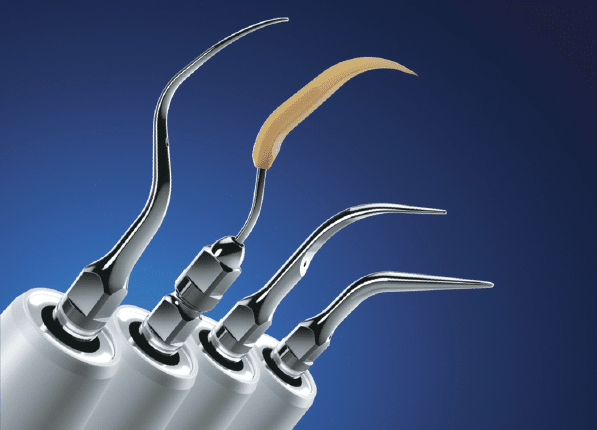
I love the piezo tips shaped like periodontal probes. They go anywhere and everywhere (just like a periodontal probe). When I use them, it feels like I am using a pencil to color away all the calculus with ease. Tips are available in a wide variety of shapes for different locations and volume of calculus.
Light deposit, healthy tissue? No problem, turn down the setting. Heavy, tenacious, smokers’ calculus that has never been cleaned before? No problem: turn up the power and water, then begin below the bridge of tartar. Watch that gunk blast off the teeth and clog your suction.
As of April 2023, I am an ultrasonic-only clinician roughly 97% of the time. I keep sharp hand instruments nearby for the rare occasion a patient truly does not tolerate the ultrasonic well. I also have a tiny over-sharpened sickle for those crazy tight-under-the contact misaligned teeth that have that last speck of deposit that cannot be reached any other way.
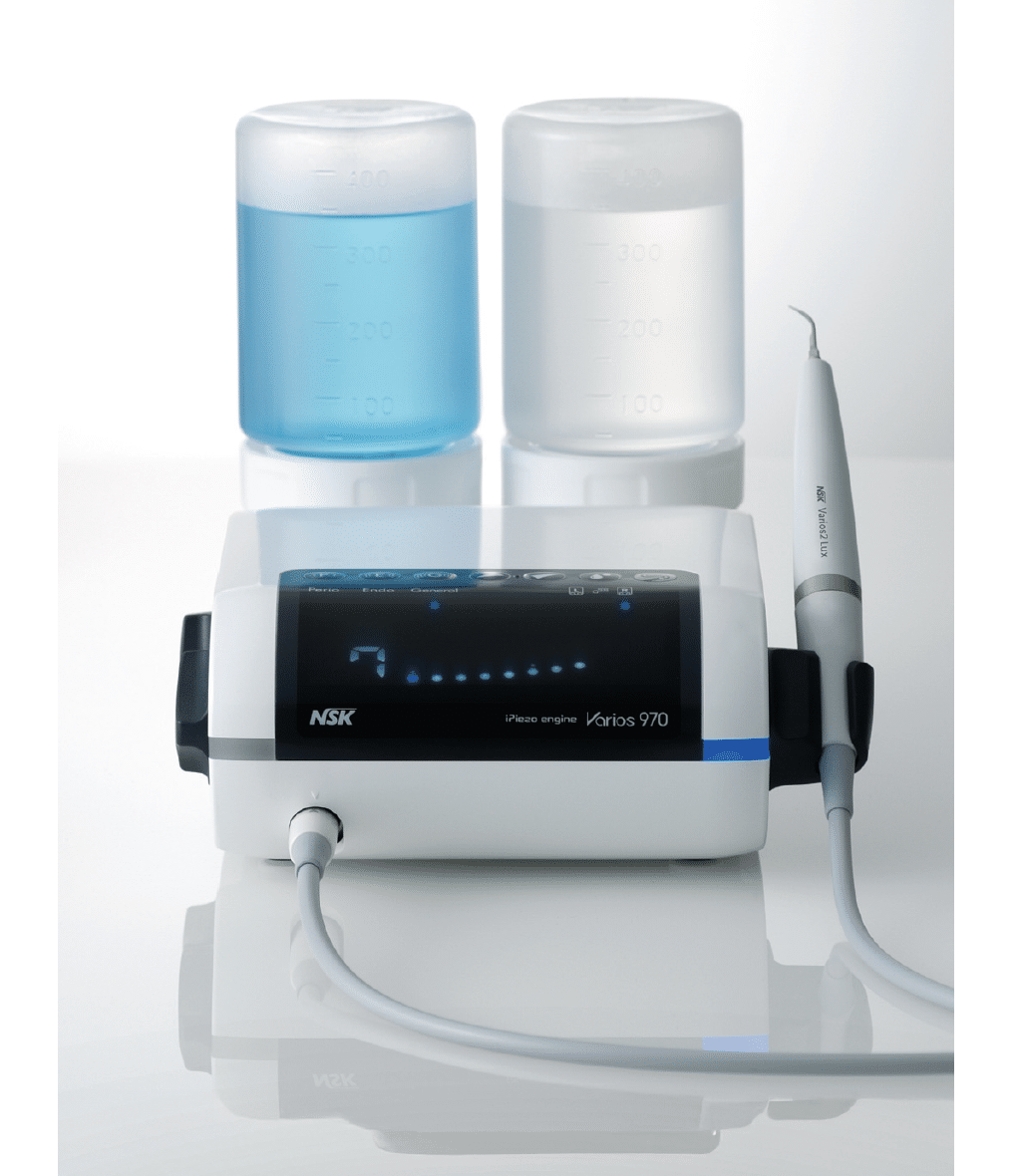
In my practice, I use the Varios 970 by NSK. The settings are easy to adjust so I can be precise with the power for a better result. The Varios is portable, making it easy to use no matter where I am working. The NSK piezo is also easy and smooth for sensitive patients. The water control is fabulous and there is no leakage. It does not heat up at all. All upgrades in my book.
Regardless of the type of ultrasonic you use, I hope you will join me in disrupting patient care and biofilm in the most profound and effective way! Get out that ultrasonic and use it to the fullest. Keep your patients excited, comfortable, and in the chair for as little time as possible. Remove more biofilm and less cementum. Let’s disrupt our way into a healthier next chapter in dentistry for us and for our patients.
NSK Dental Instruments
www.nskdental.com
888-675-1675
References
- Parashar A, Bhavsar N. Assessing the effect of piezoelectric ultrasonic scaler tip wear on root surface roughness under influence of various working parameters: A profilometric and atomic force microscopic study. J Indian Soc Periodontol. 2023;27:583-589.
- Partido B, Webb C, Carr M. Comparison of calculus detection among dental hygienists using an explorer and ultrasonic insert. Int J Dent Hygiene. 2019;17:192-198.
- Stutzer D, Hofmann M, Eick S, Scharp N, Burger J, Niederhauser T. In-vitro measurement of forces during debridement with a piezoelectric ultrasonic periodontal scaler. Oral Health Prev Dent. 2024;22:223-230.
- You X, Wu X, Chen S. Effects of a new magnetostrictive ultrasonic scaler and a traditional piezoelectric ultrasonic scaler on root surfaces and patient complaints. Sci Rep. 2024;14:6601.
From Dimensions of Dental Hygiene. May/June 2026; 24(3):26-27