
When the First Tooth Comes at Birth
Our office just had an infant present with natal teeth. What is the best approach for this unusual finding?
Our office just had an infant present with natal teeth. What is the best approach for this unusual finding?
By definition, natal teeth are present in the mouth at birth, and neonatal teeth are those that erupt in the first month after birth. They occur in approximately one in 2,000 live births.1 The most common natal or neonatal teeth are the mandibular primary incisors; rarely are they supernumerary teeth. Usually, these teeth are just an early eruption of normal primary dentition. They are often very mobile as they have little root formation and are attached only to the gingiva (Figure 1).
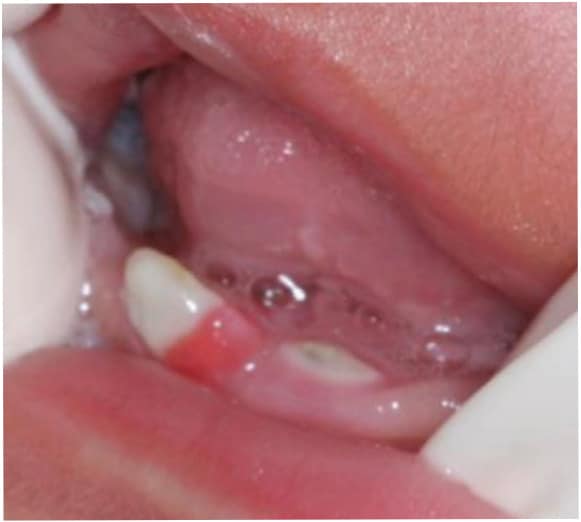
However, natal and neonatal teeth can present a challenge and possible pain to the woman who wishes to breastfeed her child. They may cause an abrasion of the mother’s nipple when sucking. To address these issues, the mother should be referred to a lactation consultant who specializes in addressing breastfeeding issues.2,3 If the presence of these teeth is not causing a problem during feeding and there is no risk of aspiration, the preferred approach is to leave the tooth (teeth) in place as it is important to the growth and development of the primary and future dentition.2,3
Another possible complication is the natal or neonatal teeth causing bleeding, ulceration, and pain to the lingual surface of the infant’s tongue (Riga-Fede disease) due to the tongue rubbing across the teeth during feeding or other oral movement (Figure 2). Should this occur, treatment options include smoothing the incisal edge of the teeth or even extracting the teeth if less invasive options do not relieve the problem. When possible, if extraction is the treatment of choice, it should be delayed until after the tenth post-natal day to avoid possible excessive bleeding.2,3
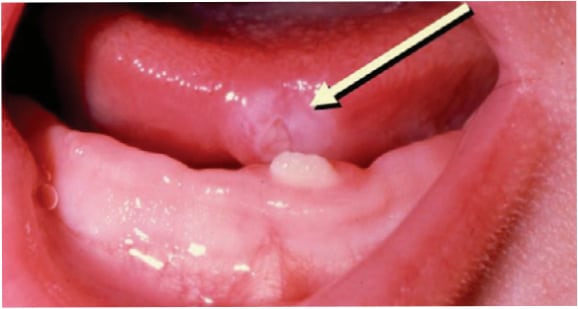
If the teeth are mobile, at risk of detachment, or pose a risk of aspiration, then extraction may be justified. All this being said, most premature erupting primary teeth occur in otherwise normal babies. But, in some cases these teeth may be a part of an underlying syndrome or condition that requires a more thorough investigation, diagnosis, and treatment.1-3
References
- American Academy of Pediatric Dentistry. Perinatal and infant oral health care. The Reference Manual of Pediatric Dentistry. Chicago: American Academy of Pediatric Dentistry; 2025:337-341.
- Holden E, DeSeta M, Siddik D, Bhujel N. Natal and neonatal teeth: a review and management recommendations. Journal of Neonatal Nursing. 2022;28(4):240-243.
- Khandelwal V, Nayak UA, Nayak PA, Bafna Y. Management of an infant having natal teeth. BMJ Case Rep. 2013;2013:bcr2013010049.
From Dimensions of Dental Hygiene. November/December 2026; 24(6):46